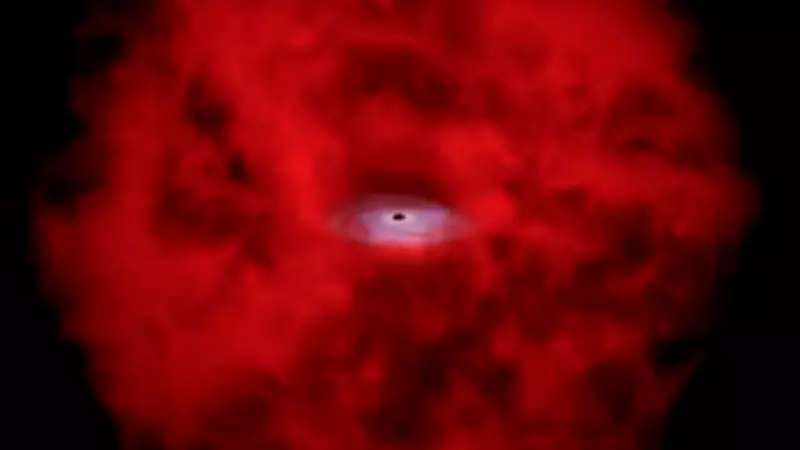
Something odd is hiding in the early universe, and astronomers are only just beginning to notice it. Using the James Webb Space Telescope (JWST), researchers have spotted faint, distant objects known as “little red dots” that do not quite behave like normal galaxies. At first, they seemed unremarkable and easy to overlook in deep space images. However, fresh X-ray observations are changing that impression.
X-ray Observations Reveal Hidden Black Holes
Data compared with findings from the Chandra X-ray Observatory now suggest these objects might be hiding something far more powerful. It appears they could contain rapidly growing supermassive black holes buried inside dense gas clouds. If confirmed, this discovery might quietly reshape how scientists understand the birth of galaxies and the origins of the universe’s most extreme objects.
The little red dots are compact objects, not exceeding several hundred light-years in diameter — exceptionally small in cosmic terms. Their reddish color indicates low temperatures compared to many other space objects, ranging from 1,700 to 3,700 degrees Celsius. While still hot, this is not comparable to most stars. Remarkably, these objects are over 11 to 12 billion years old, meaning they existed in the early universe and represent that era. Studying them can help scientists explore how the universe evolved.

Main Hypothesis: Gas Clouds with Supermassive Black Holes
The primary hypothesis regarding their nature suggests they are huge clouds of gas with a supermassive black hole inside. In this scenario, the black hole sits at the center, feeding on the gas and producing enormous energy that heats the cloud. According to The Astrophysical Journal Letters, evidence for this theory has been bolstered after scientists analyzed JWST data and compared it with Chandra data. They found X-ray emission emerging from the same locations as the tiny red spots.
X-ray radiation typically results from intense processes, most likely hot matter heated to millions of degrees as it falls into a black hole. Detecting X-rays thus proves the presence of an accreting black hole. However, a gaseous object should absorb all incoming X-rays without emitting visible radiation. Researchers now suggest there must be certain openings or windows through which part of the X-ray radiation can leak out.
Little Red Dots May Reveal How Supermassive Black Holes Are Born
Since the dawn of astronomy, scientists have wondered about the origin of supermassive black holes. Some hypotheses suggest they emerge gradually through interactions with other black holes, while others propose they form quickly when massive gas clouds collapse. The tiny red points might represent an intermediate state between these hypotheses — a black hole emerging in a dense gas cloud before developing into a bright galactic center. If confirmed, this phenomenon could be a crucial intermediary step in understanding galaxy creation.
Scientists Remain Cautious Despite New Evidence
While the findings have sparked interest, researchers are not making hasty claims. The evidence, though convincing, remains preliminary. Currently, only one instance of an X-ray signature has been linked to a small red dot. Alternative theories exist, such as odd forms of hot dust or other unique phenomena, but there is no concrete evidence supporting them. Further studies are required to validate the black hole theory, and more research is underway.
This discovery, if verified, could transform our understanding of the early universe and the formation of supermassive black holes, which are key to galaxy evolution. The James Webb Space Telescope continues to provide unprecedented views of the cosmos, revealing secrets that were previously hidden.