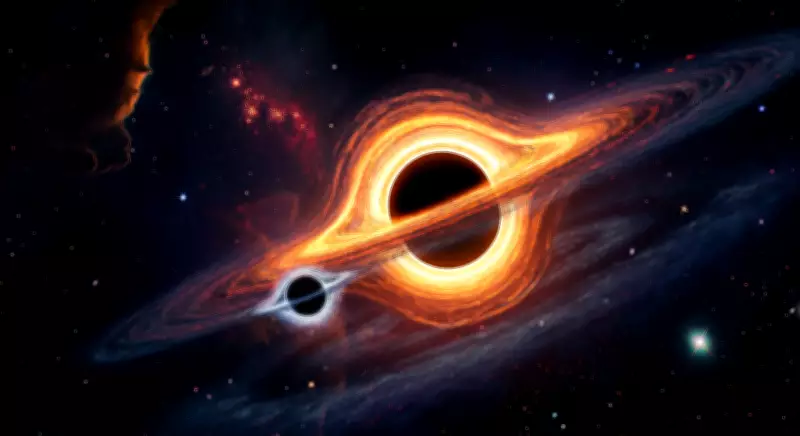
Last November, the Laser Interferometer Gravitational-Wave Observatory (LIGO) detected an unusual signal. An automated alert flagged a merger where one object had a mass lower than the Sun, which standard star-collapse models cannot explain. Now, two astrophysicists at the University of Miami suggest that this strange signal, named S251112cm, could be the first real evidence for primordial black holes (PBHs), objects believed to have formed within a tiny fraction of a second after the Big Bang. If confirmed, this discovery could have profound implications, as these ancient objects have long been suspected as a possible explanation for dark matter, the invisible substance that constitutes roughly 85% of the universe's mass. However, the researchers caution that a single signal alone is far from proof.
What is the LIGO signal S251112cm and why did it look so strange?
What made this signal stand out initially? Most black holes detected by LIGO originate from the collapse of massive stars, resulting in stellar black holes with masses ranging from a few times that of the Sun to billions of solar masses, depending on subsequent mergers. However, S251112cm involved an object with less mass than the Sun itself, which does not fit standard models. As Nico Cappelluti, associate professor in the University of Miami's Department of Physics, explained, normal stellar collapse does not produce black holes this light. This mismatch led researchers to consider that this could be something else entirely.
What are primordial black holes and why do they matter for dark matter?
Primordial black holes (PBHs) are a different type of black hole. Instead of forming from dying stars billions of years after the Big Bang, they are thought to have formed almost instantly after the Big Bang, when the universe was extremely dense and hot. Consequently, they could theoretically be almost any size, from as small as an asteroid to much larger objects. The concept is not new; it was first proposed by Soviet scientists Yakov Zeldovich and Igor Novikov in the early 1970s, and later advanced by Stephen Hawking, who suggested that PBHs could be a candidate for dark matter. For decades, this remained purely theoretical, primarily due to the lack of observational methods.

How Stephen Hawking's old black hole theory ties into this new signal
Hawking's contributions are particularly relevant here. While working on black hole radiation and evaporation, he also championed the idea of primordial black holes as a dark matter candidate. The connection is that tiny primordial black holes, if abundant enough, could account for the 'missing mass' that astronomers have long sought—the mass that holds galaxies together but does not emit light. What has changed now is not the theory itself, but the tools. Gravitational-wave astronomy, which began with LIGO's first detection in 2015, provides a new way to search for signals that older telescopes could not detect.
The University of Miami researchers behind the new primordial black hole study
The new study, led by Alberto Magaraggia along with Nico Cappelluti, was published in The Astrophysical Journal and is also available as a preprint on arXiv. The team analyzed the S251112cm detection and mathematically modeled how many primordial black holes would need to exist for LIGO to have captured such a signal. According to the University of Miami's report, their calculations suggest that these objects would be quite rare, which aligns with the infrequency of such signals in the data. If their numbers hold, primordial black holes could account for a significant portion of dark matter, possibly even all of it.
Why one signal isn't enough to confirm primordial black holes exist
However, the researchers urge caution. A single odd signal, even one as intriguing as this, is not proof on its own. It could still be noise, an instrument glitch, or an unusual but ordinary astrophysical process that has not yet been identified. Cappelluti and Magaraggia have emphasized that more detections of similar low-mass mergers are needed before concluding that primordial black holes are real. This is the nature of science: one signal opens a door, but a pattern across many signals is required for confirmation.

What's next: Cosmic Explorer, LISA, and the future of this search
Fortunately, the tools for finding more such signals are already in development. Cosmic Explorer, a next-generation ground-based observatory in the design phase, is expected to be about ten times more sensitive than LIGO, allowing it to detect fainter mergers from earlier in cosmic history, even near the formation of the first stars. Additionally, LISA, a space-based gravitational-wave mission planned for years, could open up a different range of signals once launched. With these future instruments and ongoing analysis of existing LIGO data, scientists are hopeful that within the next decade, they will either confirm primordial black holes as a real component of the universe or rule them out as a major dark matter candidate. Either way, this represents a significant step forward from where things stood just a year ago.