ISRO Study Uncovers Lightning's Impact on Satellite Navigation Systems Across India
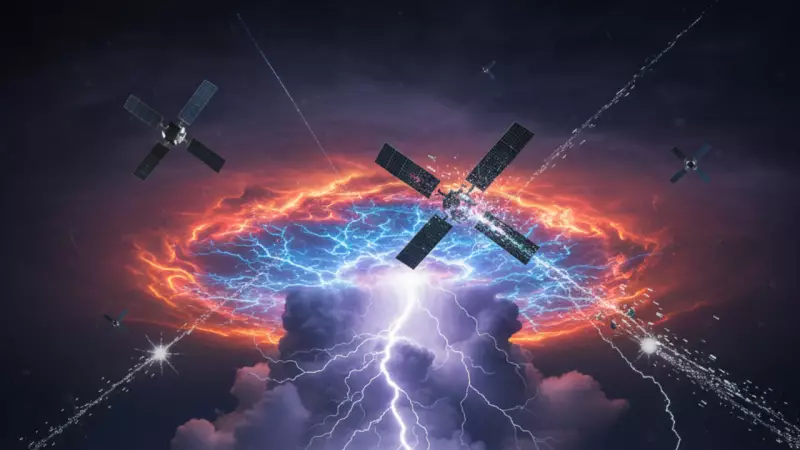
Lightning does far more than create dramatic visual displays and produce thunderous booms across the sky. A groundbreaking nationwide study conducted by the Indian Space Research Organisation (ISRO) has revealed that powerful lightning strikes can temporarily disturb the ionosphere, which is the electrically charged upper layer of Earth's atmosphere that is crucial for satellite navigation and radio communication systems.
Research Methodology and Key Findings
The comprehensive research, published in the scientific journal Remote Sensing Letters, combines extensive data from ISRO's Lightning Detection Sensor Network with precise GPS measurements collected from multiple ground stations located in Bengaluru, Hyderabad, Lucknow, and Kanpur. The research team meticulously tracked how cloud-to-ground lightning activity during March and April 2024 affected the total electron content (TEC), a critical parameter that determines how radio signals travel through the ionospheric layer.
Total electron content represents the number of free electrons along the path between a satellite and a ground-based receiver. Any changes in TEC can significantly distort signals used by global positioning systems (GPS), India's Navigation with Indian Constellation (NavIC), and other satellite-based navigation technologies. While solar activity and geomagnetic storms have long been recognized as major causes of large-scale TEC disturbances, the specific role of lightning has remained poorly understood until now.

Practical Implications for Navigation and Communication
The practical implications of these findings are substantial for navigation and communication systems that depend on precise signal timing and accuracy. "Whatever communication we receive, whether GPS signals or trans-ionospheric communications, must pass through the ionosphere. Therefore, any changes in electron density will impact all these systems," explained Alok Taori, a scientist at ISRO's National Remote Sensing Centre (NRSC) and the lead author of the study, in an interview with The Times of India.
India experiences some of the world's highest lightning activity, particularly during the pre-monsoon and monsoon months. Although the TEC variations identified in the study are relatively modest, they could contribute to positioning errors when combined with other sources of ionospheric disturbance. The researchers emphasize that lightning is not replacing solar activity as the dominant driver of ionospheric change. Instead, it adds another layer of short-term variability that current correction models often overlook.
Isolating Lightning's Effects During Daytime
"The role of lightning was less understood. While we knew solar energy could disturb the ionosphere, the question was whether some other energy source could produce similar effects during daytime," Taori noted. To isolate the specific effect of lightning, researchers focused on geomagnetically quiet days, effectively ruling out solar and space-weather influences.
The team analyzed numerous lightning events across different regions of India and compared them with minute-by-minute GPS-derived TEC data from stations in Bengaluru, Hyderabad, Kanpur, and Lucknow. What emerged was a consistent and revealing pattern: strong lightning discharges were consistently followed by small but measurable TEC fluctuations, typically occurring within two to thirty-five minutes after the strike.
Quantifying the Disturbance
The observed changes ranged from approximately 0.05 to 0.8 TEC units, depending directly on the intensity of the lightning current. "We found that lightning also creates a type of variation that is approximately one-fifth of whatever the Sun actually does," Taori stated, providing a clear comparison between these atmospheric phenomena.
The study also identified a weak but statistically clear linear relationship between lightning current strength and the magnitude of the TEC disturbance. In simpler terms, stronger lightning flashes were more likely to produce larger ionospheric effects. These disturbances appeared as sharp spikes superimposed on slower atmospheric waves generated by thunderstorms.

Significance of Daytime Observations
Importantly, these effects were observed during daytime hours when the ionosphere is already dense and relatively stable. Previous studies had largely concentrated on nighttime disturbances or examined single lightning events in isolation. By utilizing multiple stations and analyzing several lightning-active days across India, this new research provides the first systematic evidence of lightning-driven TEC changes over the region.
As satellite-based services continue to expand across India and globally, the study highlights the growing need to factor in not just space weather phenomena, but also what is occurring far below, within Earth's most violent atmospheric storms. "That much error has to be taken into account whenever you are doing positioning," Taori emphasized, pointing to applications ranging from civilian navigation to more sensitive systems that rely on high accuracy for critical operations.