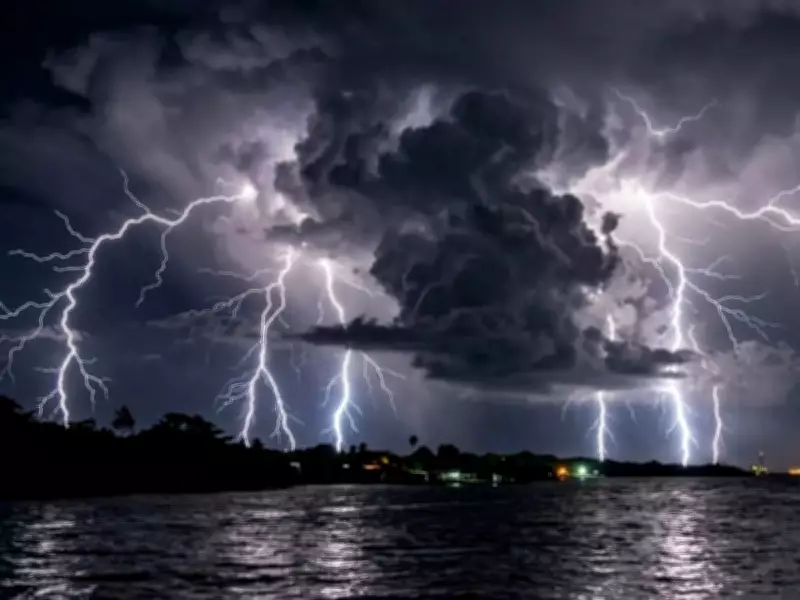
Not all regions of the Earth are equally exposed to storms. Some areas have developed such high levels of electrical activity that they are classified as lightning hotspots. These are places where storms form repeatedly under the same atmospheric conditions, often night after night.
Lake Maracaibo: The New Lightning Capital
A particularly powerful lightning hotspot is Lake Maracaibo in Venezuela. According to NASA's latest lightning maps, this tropical area is now considered the most active lightning hotspot in the world. Previously, the Congo Basin was believed to hold the title, but new research has shifted the ranking.
Such phenomena are not uncommon in tropical zones. The Earth's atmosphere provides favorable conditions for constant storms, with warm air, moisture, and wind patterns creating natural factories of lightning.

Why Tropical Zones Produce Abundant Lightning
Lightning hotspots are unevenly distributed across the globe. Most occur over continents in tropical regions due to high temperatures. During the day, the ground heats up under sunlight, causing warm, humid air to rise rapidly into the atmosphere. This rising air triggers thunderstorm formation. Tropical areas are particularly active because humidity remains high year-round, fueling thunderclouds.
The Congo Basin is a classic example of this pattern. Although new data has given the top spot to Lake Maracaibo, Central Africa still hosts many highly active storm areas. According to NASA, six of the ten most lightning-active areas are in Africa.
Why Storms Form in Lake Maracaibo at Night
One reason Lake Maracaibo remains stormy even after sunset is timing. Most storms weaken at night, but here, nighttime is more active. NASA Earthdata explains that winds blowing from surrounding mountains drive this unique activity. Cool air from the mountains meets warm air in the basin, triggering thunderstorms. From the surface, the effect seems continuous as lightning strikes the horizon while new clouds form simultaneously.
Some researchers call this phenomenon “Catatumbo lightning,” named after the nearby Catatumbo River where storms typically occur. A meteorologist working with NASA describes this region as one of the most electrically charged on Earth, based on satellite observations.
How Improved Satellite Maps Changed Rankings
In earlier studies, scientists believed the highest lightning concentration was in the Congo Basin, using low-resolution satellites. With advancements in satellite technology, data from NASA’s Lightning Imaging Sensor revealed that Lake Maracaibo is more lightning-rich than the Congo Basin. This demonstrates how rankings can change with technological progress. Improvements did not diminish the Congo Basin's significance but helped identify the region with maximum lightning activity. The tropical storm region spanning Africa and South America remains one of the busiest places on Earth.
What Makes Lightning Hotspots Relentless
Lightning hotspots share common characteristics. They provide ample warmth and moisture, are often located near bodies of water, mountain ranges, or coasts that influence local air currents, and have cyclical weather patterns. This repetition gives hotspots their relentless nature. According to NASA, when atmospheric conditions align, thunderstorms can form repeatedly in the same region. Warm air rises, wind mixes, moisture condenses, and a new storm is created. These processes may continue for hours and occur daily during thunderstorm seasons.
Locals experience unique lightning storms every night, witnessing one of the most powerful natural shows in the world. Scientists study these hotspots because lightning behavior reveals much about climate, precipitation, and global weather conditions.
In conclusion, these locations have special conditions that make them perfect storm generators. Wherever they are, lightning is not a sporadic phenomenon but a regular nighttime occurrence.