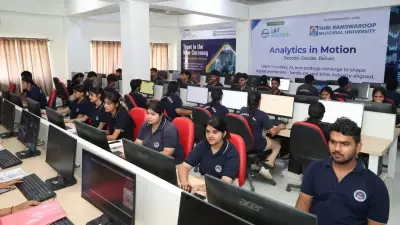
Gujarat's Indian Institute of Technology Gandhinagar hosted a significant gathering this week, bringing together minds focused on the future of computational fluid dynamics. The three-day International Symposium on Artificial Intelligence–Driven Computational Fluid Dynamics opened on Monday, January 12, 2026, with experts emphasizing a transformative shift in the field.
AI as an Indispensable Tool for Complex Simulations
The symposium began with traditional lamp lighting and a welcome from Conference Chair Prof Vinod Narayanan. The core message from inaugural speakers was clear: traditional computational methods are struggling to keep up. Prof Akshai K Runchal of Analytic and Computational Research Inc (ACRi) stated that AI now provides essential tools to accelerate solutions for these increasingly complex simulations.
"Traditional methods alone can no longer keep pace," Prof Runchal explained during his address. "AI provides tools to accelerate solutions, though it must be used responsibly." He detailed how artificial intelligence can bridge the gap between theoretical models and real-world data, creating simulations that are both more accurate and vastly more efficient than older approaches.

Transforming Engineering Challenges
Prof Rajat Moona, Director of IIT Gandhinagar, echoed this sentiment, calling AI a sophisticated statistical system capable of tackling problems previously deemed computationally impossible. "Its integration with Computational Fluid Dynamics will transform the way complex engineering challenges are solved," he asserted.
To illustrate the dramatic progress, Prof Moona shared a personal anecdote from his PhD research. He recalled how even simple computational models could require days or weeks of runtime due to severe hardware limitations. "Even a small weather simulation at that time could take 24 hours of uninterrupted computation," he said, highlighting the challenges of managing power and data availability. This historical context underscored why high-performance computing and AI have become non-negotiable tools for modern engineers and researchers.
Fostering Global Collaboration and Innovation
A key objective of the symposium, which runs until January 14, is to build stronger collaborative networks. Prof Runchal stressed that the event aims to connect leading researchers from India and around the world. The goal is to encourage joint programs, spark innovative research, and inform policymakers about viable technological solutions.
The interdisciplinary focus of the meeting is on merging artificial intelligence with computational fluid dynamics. This fusion aims to cultivate novel problem-solving methods and equip participants with the latest tools to tackle intricate challenges in fluid dynamics. Prof Runchal emphasized the pervasive role of CFD, noting, "There is no aspect of human industry or activity today where CFD does not play a role." This universality makes the advancements discussed at IIT Gandhinagar critically important for numerous sectors.
The gathering at IIT Gandhinagar represents a forward-looking step for a field integral to countless industries. By harnessing the power of AI, researchers are paving the way for faster, more reliable simulations that will drive innovation in engineering, environmental science, and beyond.