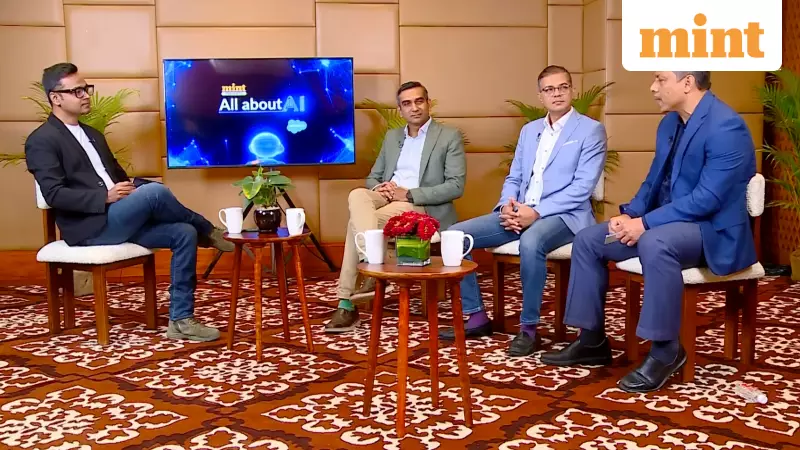
The Artificial Intelligence wave is fundamentally altering how businesses operate globally. For Indian companies, from ambitious startups to legacy corporations, the pivotal question is no longer about merely adopting AI, but about strategically weaving it into their existing frameworks to extract tangible, measurable value. This central challenge formed the core of a recent high-level discussion on Mint's All About AI series, powered by Salesforce.
India's AI Ecosystem: Scale, Talent, and Ambition
The dialogue, featuring Amarendra Kumar from Salesforce India, Prashanth Kaddi from Deloitte, and Aditya Priyadarshan from Accenture, first mapped India's unique position in the global AI landscape. A key strength lies in its vast human capital. India produces approximately 9.8 million STEM graduates annually, creating a formidable talent pipeline. Kumar highlighted that for Salesforce, India represents the largest talent pool outside the United States.
This reservoir of skill is crucial for System Integrators (SIs) and advisory firms, who act as essential bridges. Their role is to translate powerful AI platforms into customised solutions that address specific business problems. Kumar emphasised that this partner ecosystem is not only robust and stable but also serves as a growth engine for both the domestic market and international projects.

The Orchestrator's Role and the Urgency of Change
The panellists viewed their function as that of strategic orchestrators. Priyadarshan explained that the journey begins with clear problem articulation. "Our role is as an advisor to the client, helping them articulate very clearly what exactly they are solving for," he stated. Partners must tailor platform technology to deliver precise business outcomes.
Kaddi reinforced that in today's complex transformation landscape, no single entity has all the answers, making collaboration and orchestration vital. He also pointed to a growing sense of urgency among Indian enterprises. "The period of disruption is shrinking so quickly that you better disrupt yourself before you're disrupted by someone else," Kaddi noted. The conversation has decisively shifted from 'if' to 'when and how' businesses should adopt AI.
However, the path is not without hurdles. Kumar observed that successful integration often requires more than a technology shift; it demands a change in the organisational fabric itself, especially when navigating legacy systems and entrenched mindsets.
The Human Element and India's Leapfrogging Potential
A unanimous point of agreement was the irreplaceable importance of the human factor. As AI changes job roles, leadership commitment to communication and reskilling becomes paramount. The goal is augmentation, not replacement. Priyadarshan dismissed fears of massive job losses, stating that success will hinge on the workforce's ability to upskill and adapt, focusing on higher-value work as AI handles routine tasks.
India is poised not to follow but to leapfrog in AI adoption, much like it did with mobile telephony and UPI payments. Kaddi challenged the notion of India being behind, citing homegrown innovations. "The issue earlier was... solutions were built for a different market... Now you look for examples in India. Just look at number of payment transactions that UPI does. There is no other parallel," he said.
This rapid adoption is visible in enterprise AI, where some organisations are already planning to leapfrog multiple technology generations. To capitalise on this moment, Priyadarshan outlined a four-action plan for businesses: Lead with Value, Rewire the Organisation, Adopt Agentic AI, and crucially, Get Data Ready.
Defining the Future: Augmented Intelligence and Possibilities
In closing, the leaders encapsulated the AI era in single concepts. Kaddi championed 'Augmented Intelligence' as a force that will amplify human creativity. Priyadarshan termed AI the 'Future', envisioning an exciting new vantage point for the next generation. Kumar defined it simply as 'Possibilities', highlighting the technology's boundless versatility.

The panel concluded with shared optimism. While every industry will undergo change, this transformation presents a significant opportunity for Indian businesses to secure a formidable competitive edge on the world stage.
Note: This editorial initiative is sponsored by Salesforce.