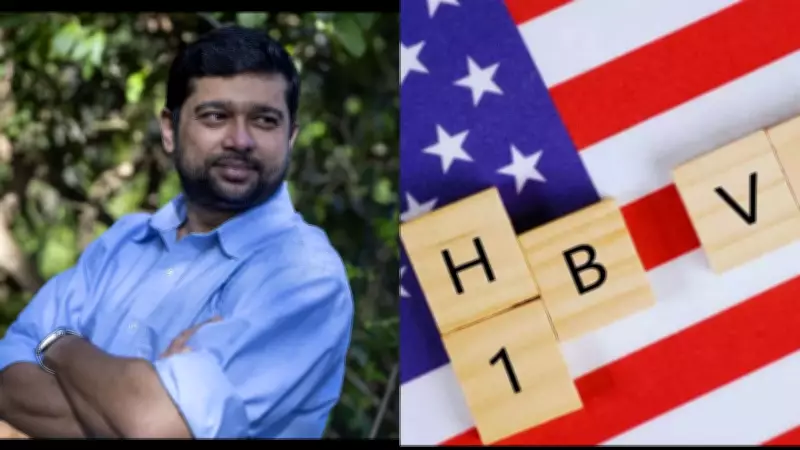
When President Donald Trump announced the $100,000 fee for H-1B visas last September, Indian techie Abhishek Abhyankar was in India for his wedding. At that time, it was not immediately clear who would have to pay the fee. Abhyankar recalled that his friends panicked and urged him to book the first flight to Seattle and attend his reception virtually from the US. Abhyankar refused, and later he and his wife, who is also an H-1B visa holder, did not face any issues returning to the US. However, neither of them forgot the incident, and it served as a reminder of how conditional their status is in the US. "That created a lot of panic and uncertainty," he said.
Understanding the $100,000 H-1B Visa Fee
The $100,000 H-1B visa fee is for companies to pay when they make a new petition to hire from outside the US on the H-1B visa. It was not meant for Abhyankar, who has completed a decade in the US. Abhyankar told the Seattle Times that he came to the US in 2014 for his graduate studies and then got a job and settled down. His employer had already applied for his Green Card in 2017. But he does not see himself becoming a permanent resident in the US, not because of the long waiting time, but because he sees himself returning to India eventually. "The uncertainty of not being in a correct status looms heavily on my mind," he said.
Pattern of Confusion and Clarifications
For foreign-born workers in the US, it is one announcement after another, followed by clarifications later. For example, when the $100,000 H-1B visa fee was announced, there was no clarity on who would have to pay it. Panic spread as visa holders thought everyone outside the country would have to pay the fee. Later, it was stated that companies hiring H-1B visa holders after the date of the proclamation would have to pay the fee. Similarly, the Trump administration recently announced that non-immigrant visa holders would not be allowed to wait for their Green Cards in the US; they would have to go back to their countries and come through the consular process. Days later, the administration said there was no need to panic as most visa holders would get to stay in the US.

This cycle of announcements and clarifications has left many H-1B visa holders in a state of perpetual uncertainty, impacting their personal and professional lives. Abhyankar's experience is just one example of the broader challenges faced by skilled immigrants in the US.