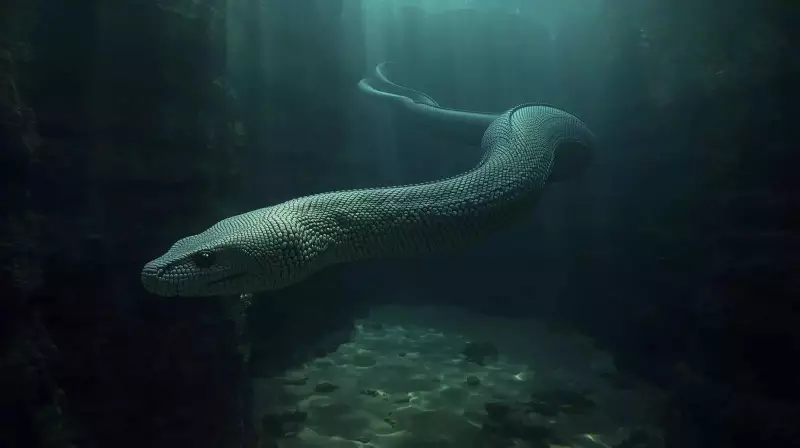
Giant Sea Snake Discovery Rewrites Marine History
For decades, people imagined giant animals as land-dwelling dinosaurs. Oceans seemed quieter, hiding their deep secrets. Fossils sometimes reveal creatures that once swam through warm seas in ways we can barely imagine today.
One remarkable animal emerges from scattered bones rather than a complete skeleton. These remains demand attention. They belong to a sea snake that lived millions of years before humans walked the Earth. This creature did not share waters with modern whales or coral reefs. Instead, it navigated shallow ancient seas that have long since vanished.
Meet Palaeophis Colossaeus: The Colossal Sea Snake
Palaeophis colossaeus represents the largest sea snake ever discovered. It thrived during the Eocene epoch, approximately 56 to 34 million years ago. Scientists know this animal only from fossilized vertebrae. These bones are exceptionally large.

Researchers estimate the snake measured between 8 and over 12 meters in length. That size far exceeds any living sea snake today. A 2018 study titled "Large palaeophiid and nigerophiid snakes from Paleogene Trans-Saharan Seaway deposits of Mali" described these vertebrae as larger than those of any known modern snake species, whether marine or land-based.
Even without a skull or complete body, the scale of these bones suggests an animal built for dominance. This was not a creature surviving at the margins. It was a top predator in its ecosystem.
Ancient African Waters Hosted This Giant
Evidence points to a warm, shallow marine environment that once covered parts of North Africa. This region, known as the Trans-Saharan Seaway, existed when global temperatures were higher than today. Areas that are now desert were once coastal waters teeming with life.
The presence of such a large sea snake indicates these seas were warmer than modern tropical oceans. Large reptiles depend on external heat to regulate their body temperature. Sustaining such enormous size would have been impossible in cooler conditions.
This environment likely supported diverse marine life. Fish, sharks, and other marine reptiles created a rich ecosystem. This diversity provided space for a predator of unusual dimensions.
What Did This Giant Snake Eat?
No direct evidence shows the diet of Palaeophis colossaeus. However, its massive size offers clear clues. A snake measuring more than 10 meters would have required substantial meals.
Researchers suggest that if its skull was highly flexible, like many modern snakes, it could have swallowed very large prey. Potential meals might have included sizable fish, sharks, or crocodile-like reptiles called dyrosaurids.
This idea represents basic biological reasoning rather than dramatic speculation. Large predators typically target large animals. Scientists remain cautious, though, since only vertebrae have been found. Reconstructing behavior proves more challenging than analyzing bones.
Comparing Ancient Giants to Modern Snakes
Modern sea snakes appear far smaller and less imposing. The longest living species, the yellow sea snake, reaches about 3 meters at most. Even the largest known snake, Titanoboa, which lived on land, measured only slightly longer than Palaeophis colossaeus. That animal is also extinct.
Today's oceans contain scaled-down versions adapted to cooler seas and different food chains. The giant sea snake belongs to a time when oceans functioned differently. Its disappearance lacks a neat ending. It simply faded away as climates shifted, seas retreated, and the world rearranged itself around smaller life forms.