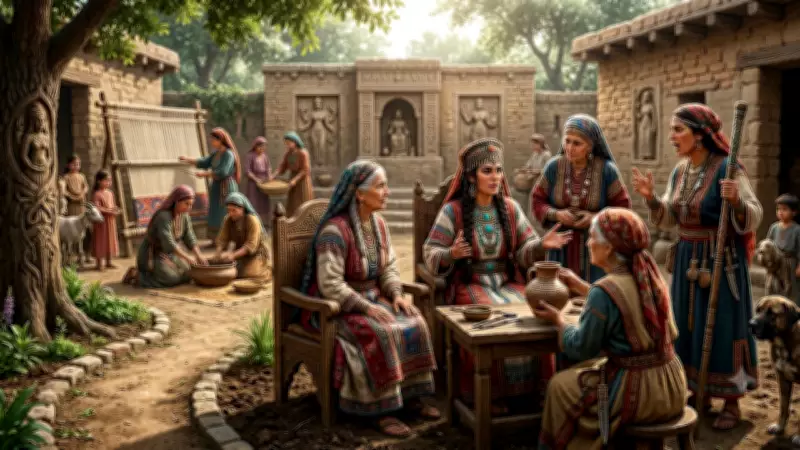
For more than six decades, Çatalhöyük has challenged archaeologists' assumptions about how the world's earliest farming communities were organised. The vast Neolithic settlement in central Anatolia, occupied between roughly 7000 and 6000 BCE, has yielded thousands of burials, elaborate wall paintings, figurines, and densely packed mudbrick homes. Yet one question remained unresolved: were women central to the community's social structure, or were earlier interpretations influenced by modern assumptions?
Landmark Genomic Study
A landmark genomic study has now provided the strongest evidence yet that kinship at Çatalhöyük was organised primarily through maternal lines. By analysing 131 ancient genomes recovered from individuals buried beneath house floors, researchers found that female relatives formed the enduring social backbone of households, while males were more likely to move between residences. The findings offer the oldest genetically documented example of a female-centred social organisation among early farming societies and are reshaping archaeological understanding of gender, kinship, and community life in the Neolithic world.
Ancient DNA from 131 Skeletons Reveals Maternal Lineages
The study ‘Female lineages and changing kinship patterns in Neolithic Çatalhöyük’ combined palaeogenomics with decades of archaeological evidence from one of the world's best-preserved Neolithic settlements. Researchers examined DNA from 131 individuals buried in 35 buildings across the east mound of Çatalhöyük. Their results showed that close relatives buried within the same house were frequently connected through maternal ancestry. Female offspring often remained linked to specific households across generations, creating a pattern consistent with matrilocal residence, where women stayed within their ancestral homes while men moved after marriage.

According to the study: "Comparing genetic ties within and between buildings, we found that the maternal lineage had a key role in connecting Çatalhöyük household members."
The researchers also observed that this maternal continuity persisted even as social organisation evolved during the settlement's nearly 1000-year occupation, dated from 7000 to 6000 BCE. These findings directly challenge the long-standing assumption that early agricultural societies were predominantly organised around paternal descent.
Girls Received More Burial Goods Than Boys
The genetic evidence was reinforced by burial practices. Researchers examined grave goods associated with children and infants whose biological sex could now be identified through DNA analysis. The study found that young females were consistently buried with significantly more ornaments and symbolic objects than males. Some analyses indicate girls received up to five times more grave goods than boys, a pattern rarely documented in prehistoric societies.
Dr. Eline M.J. Schotsmans, a researcher at the University of Wollongong who contributed significantly to the study, noted: "We need to move away from our Western bias that assumes all societies are patrilineal."
Importantly, the evidence does not point to a rigid matriarchy in which women dominated men. Instead, researchers describe a female-centred and largely egalitarian society where maternal kinship played a defining role in household continuity and social identity.
Why the Discovery Changes Our Understanding
Çatalhöyük has long occupied a unique place in archaeology. Home to several thousand people at its peak, it represents one of humanity's earliest large-scale farming settlements and is recognised as a UNESCO World Heritage site. The site's famous female figurines, including the celebrated "Seated Woman of Çatalhöyük", previously fuelled speculation about goddess worship and female authority. However, those interpretations remained controversial because they relied largely on symbolic artefacts rather than direct evidence of social organisation.
Ancient DNA has now shifted the debate from interpretation to measurable biological relationships. Evolutionary geneticist Mehmet Somel, one of the study's lead authors, described the findings as "the oldest genetically-inferred social organisation pattern in food-producing societies," which "turns out to be female-centred."

The discovery is significant because most later Neolithic communities in Europe display predominantly patrilocal patterns, where women moved into male households after marriage. Çatalhöyük appears to represent a different social pathway during a crucial period when agriculture, permanent settlements, and complex communities were emerging.