Cuba is experiencing its most severe energy crisis in decades, with the national grid collapsing multiple times since 2024, leaving millions without power for days. As of early 2026, eight major thermal generation plants are offline, operating plants run at only 34 per cent capacity, and daily power shortfalls exceed 1,500 megawatts. Fuel deliveries from Venezuela have dropped sharply, foreign currency reserves are insufficient for alternatives, and a January 2026 US executive order imposing tariffs on countries supplying oil to Cuba has exacerbated the situation. Amid this backdrop, a 21-year-old from the outskirts of Havana has developed a practical solution: a workshop that installs solar panels on electric tricycles, enabling workers to complete their daily routes.
Electric Tricycles: A Lifeline Under Strain
Electric tricycles have become a common sight in Havana, offering a solution to fuel scarcity and strained public transport. For many residents, these battery-powered vehicles are essential for transporting goods, passengers, and running delivery services. However, the energy crisis also affects these tricycles, as wall-outlet charging depends on grid availability. In 2025, daily power interruptions averaged 1,531 megawatts, peaking at over 2,000 megawatts. A driver unable to charge their battery loses income for the day, and a dead battery mid-route represents a direct financial loss.
Yadán Pablo Espinosa's Solar Solution
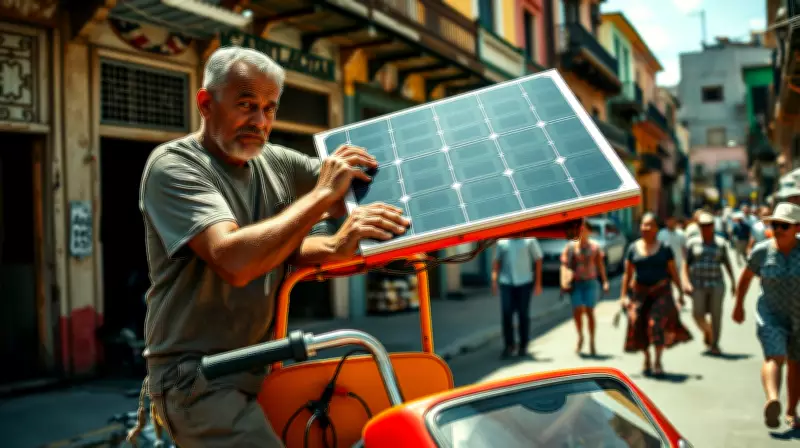
Yadán Pablo Espinosa, 21, operating from the Arroyo Naranjo district on Havana's southern outskirts, conceived a simple idea: install a solar panel on the roof of an electric tricycle to harness sunlight and reduce battery drain. He established a small workshop with his father, three brothers, and a friend, and within a month, they had installed solar panels on over 15 electric tricycles. The panels, rated between 550 and 650 watts, send power directly to the motor while moving and switch to charging the battery when stationary. This dual-mode setup supports drive and passive charging, optimizing for the stop-start nature of urban tricycle use. The metal frame holding the panel also serves as a roof, providing shade and rain cover.

Solar Potential in Cuba
Cuba's solar resource is significant, with the Ministry of Energy and Mines estimating solar radiation at approximately 0.46 kilowatt-hours per square foot per day. A 550 to 650-watt panel under good sunlight can generate 2.6 to 3.2 kilowatt-hours of usable energy daily. While not enough to replace a full charge, this can meaningfully extend range, especially for short urban trips with regular stops. This represents battery relief, potentially reducing battery drain by 20 to 30 per cent and adding working hours for drivers operating eight to ten hours daily.
Two drivers confirmed the practical benefits. Yoandis Castro, 47, who transports goods, noted the panel aids charging. Orlando Muñoz, 62, who carries passengers near the busy 100 and Boyeros Avenue corridor, reported improved performance and extended battery life. These modest operational improvements are critical when every charged battery is a valuable resource.
National Solar Push vs. Street-Level Innovation
The Cuban government has pursued renewable energy through its National Strategy for Energy Transition, approved in March 2025, aiming for 24 per cent renewable electricity by 2030. Grid-connected solar capacity grew from 280 megawatts at end-2024 to 1,084 megawatts by end-2025. In February 2026, Cuba generated over 800 megawatts from solar in a single day for the first time. China's solar panel exports to Cuba rose from $3 million in 2023 to $117 million in 2025. However, grid-scale projects do not address the immediate needs of individual tricycle drivers. Espinosa's workshop fills a gap that state infrastructure cannot reach, supporting the street-level economy that keeps goods moving.

Scaling Challenges and Significance
Espinosa's initiative emerged from a family workshop without state subsidies, university research, or manufacturer partnerships. This origin highlights how people adapt when official systems are slow. However, there are limitations: panel costs may be prohibitive for some drivers, supply chains can be disrupted, and solar roofs must withstand vibration, rain, rough roads, and tropical heat while ensuring safety. Despite these challenges, 15 installations in under a month, with drivers reporting improved battery performance, demonstrate the concept's viability. In a country where grid power has declined and solar emerges as a lifeline, this innovation matters.