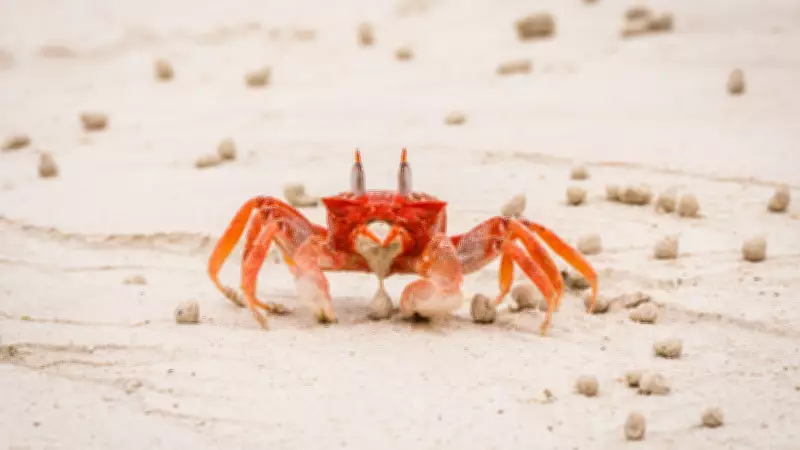
The process of carcinisation, evolution of crabs, sideways movement, crustaceans, convergent evolution, and decapods and true crabs are all involved in an intriguing scientific riddle. It explores how such varied organisms evolve into crabs, yet have only one common ancestor when it comes to sideways locomotion.
What Is Carcinisation and Why Does It Occur Across Various Groups?
Carcinisation is the term used for the independent evolution of crab-like morphology in various groups of crustaceans. It involves a flat body form, an abbreviated abdomen hidden underneath the thorax, and a large shield covering the carapace. This repeated evolution has been observed in diverse groups of decapod crustaceans, such as hermit crabs and squat lobsters.
As noted by renowned researcher Joanna Wolfe, "Carcinisation represents one of the most impressive examples of convergent evolution on record." This repetition implies strong selective advantages due to the crab-like form, including enhanced defence mechanisms, increased manoeuvrability in small spaces, and efficient burrowing skills.

Sideways Walking: A Unique Evolutionary Event
Even though carcinisation has occurred multiple times, sideways walking appears to have evolved only once among true crabs (Brachyura). Sideways walking is possible due to jointed legs that move laterally rather than longitudinally. According to the Journal of Experimental Biology, "The lateral gait of brachyuran crabs is related to an extraordinary reorientation of limb articulation in contrast to other decapods." This means that while other creatures may resemble crabs in physical appearance, they may not share their mode of locomotion.
Why Didn't Sideways Walking Evolve Multiple Times?
This is likely due to evolutionary trade-offs. Walking sideways is effective for stability and efficiency at high speeds on rough terrain, but it requires extensive changes to an organism’s anatomy. In most crustaceans, forward walking persists as an adaptation because it is relatively easy to achieve and serves them well in their habitats. Research on circadian rhythms in zebrafish behaviour highlights that "functional constraints limit the repeated evolution of certain locomotor strategies, even when body forms converge." In other words, evolving a crab-like shape is easier than developing the ability to walk sideways.
The Evolutionary Advantage of Being Crab-Like
Crab-like structures offer various advantages, such as reduced vulnerability due to a smaller body size, protection from a hard shell, and efficient environmental interaction through limb positioning. This explains why carcinisation continues to recur. Additionally, crab-like sideways locomotion adds an element of efficiency, making true crabs particularly effective in coastal and intertidal environments where speed and agility are crucial for survival and manoeuvrability.
While the phrase "everything evolves into crabs" may seem to reflect reality, it misses the point. Carcinisation shows how nature recycles proven design concepts, but sideways movement remains a novel evolutionary trait that emerged only once.