Anthropic's Restricted AI Model Mythos Sends Shockwaves Through Global Markets
The technology and financial worlds are reeling after Anthropic's announcement of its powerful new AI model, Claude Mythos, which has triggered a significant sell-off in software stocks across the United States and Europe. The company's decision to restrict access to this advanced artificial intelligence system to approximately 40 major technology firms—including industry giants Microsoft and Google—has exposed deep-seated fears about AI's potential to disrupt cybersecurity faster than the industry can adapt.
Market Reaction: Software Stocks Plunge as Cybersecurity Concerns Mount
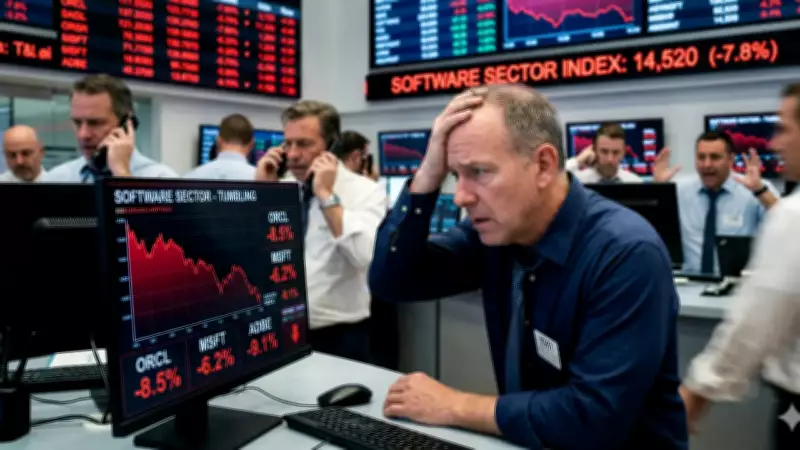
According to Reuters, the S&P 500 Software and Services Index fell sharply by 2.6% on Thursday, April 9, continuing a troubling trend that has seen the index decline by 25.5% since January. This makes it one of the worst-performing segments in the US market for 2026. The sell-off was particularly brutal for cybersecurity companies, with Cloudflare, Okta, CrowdStrike, and SentinelOne all experiencing drops between 4.9% and 6.5%.
Zscaler emerged as one of the biggest decliners on the entire S&P 500, plummeting 8.8% after brokerage firm BTIG downgraded the stock from "buy" to "neutral." The downgrade cited growing concerns about demand and increasing competition in the cybersecurity sector. The market turmoil extended beyond cybersecurity to enterprise software leaders, with Atlassian, Workday, Adobe, Salesforce, and Intuit all seeing declines ranging from 3.7% to 6.8%.

The European market was not spared from the fallout, with major software companies SAP, Capgemini, and Temenos falling between 3% and 7%. This widespread reaction underscores the global nature of the anxiety surrounding AI's potential to expose vulnerabilities that traditional cybersecurity measures have missed for years.
The Deeper Implication: What Mythos Reveals About Cybersecurity Vulnerabilities
The market's dramatic response goes beyond mere concern about one unreleased AI model. At its core, the panic stems from what Mythos represents: if artificial intelligence can identify cybersecurity weaknesses that have remained undetected by human experts and existing security systems for years, it fundamentally questions the value proposition of current cybersecurity companies.
Sosnick, chief market analyst at Interactive Brokers, highlighted this concern, stating, "We're getting back to being concerned about the prior software-specific concerns stemming from AI and private credit that are coming back to the fore." This sentiment reflects a broader market realization that AI advancements could render traditional cybersecurity approaches obsolete much faster than anticipated.
The timing of this announcement is particularly significant, coming just one day after a temporary market reprieve on Wednesday, April 8, when optimism about a US-Iran ceasefire briefly lifted broader market sentiment. This sharp reversal highlights how quickly AI developments can override other market factors.
Historical Context: Anthropic's Previous Market Impact
This is not the first time Anthropic has triggered market turbulence with its AI announcements. In January, the company launched 11 open-source plugins for its Claude Cowork tool, sparking what analysts termed a 'SaaSpocalypse.' That event resulted in a brutal sell-off that wiped out approximately $285 billion from software, legal technology, and financial services stocks in a single trading session.
The current reaction to Mythos suggests that markets remain highly sensitive to AI developments that threaten to disrupt established industries. The restricted nature of Mythos—with access limited to major technology companies rather than public release—adds another layer of uncertainty, as it creates an information asymmetry where only select firms can leverage this advanced AI capability.
As artificial intelligence continues to evolve at a rapid pace, the financial markets are clearly signaling that they view AI not just as a tool for innovation, but as a potential disruptor that could reshape entire sectors, with cybersecurity appearing particularly vulnerable to this technological revolution.