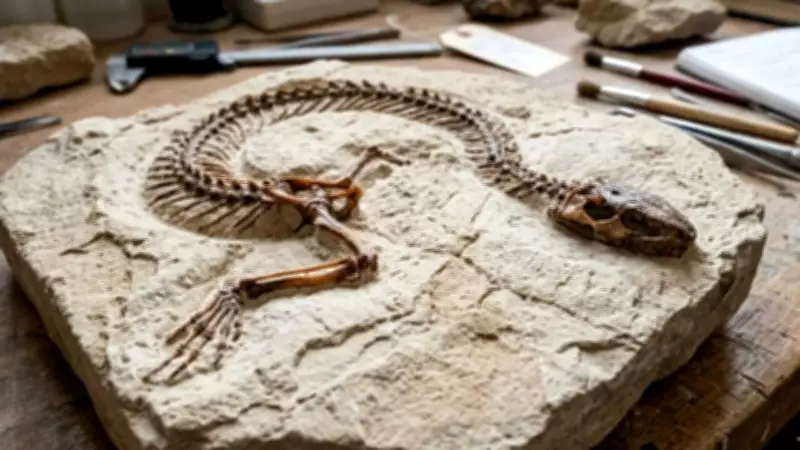
The discovery of an ancient snake fossil has fundamentally altered scientific perspectives on snake evolution. Approximately one hundred million years ago, certain snakes retained incomplete limbs, including hind legs and other physical traits that have been entirely lost in most modern snakes over time.
The Najash rionegrina Fossil: A Window into the Past
The fossil in question belongs to an extinct snake species called Najash rionegrina, unearthed in Argentina. This discovery is significant not only because of the presence of legs but also due to a facial structure—the cheekbone—that helps scientists understand how modern snake anatomy evolved.
Challenging Previous Evolutionary Theories
For a long time, it was believed that snakes evolved from small, subterranean creatures that gradually lost their limbs. However, this fossil suggests a more complex scenario. Instead of being tiny underground dwellers, some primitive snakes were large and lived on land. The existence of hind limbs indicates that limb loss was not sudden but occurred gradually over time, implying that snakes retained certain ancestral characteristics for extended periods during evolution.

The Cheekbone and Skull Evolution
The presence of a cheekbone, or jugal bone, in the fossil is particularly noteworthy. This bone is common in lizards but typically absent in modern snakes. According to the study “New Skulls and Skeletons of the Cretaceous Legged Snake Najash, and the Evolution of the Modern Snake Body Plan” published in Science Advances, early snakes still possessed this cheekbone, which later disappeared as snake skulls evolved into their modern, flexible form. This discovery provides evidence that early snakes had cheekbones and sheds light on the evolutionary reduction of skull bones over time.
Insights into Snake Evolution
The Najash rionegrina fossil enhances our understanding of how snakes evolved from their reptile ancestors. It indicates that ancient snakes exhibited a combination of traits, such as limbs and more complex skull structures, compared to modern snakes. This highlights that evolution is a gradual process, not a straightforward linear progression.
Implications for Modern Understanding
These fossilized remains shed new light on the evolution of modern snakes, revealing that they underwent multiple evolutionary stages, retaining both hind legs and cheekbones. Such findings enrich our knowledge of how species evolve, demonstrating that even seemingly simple creatures like snakes have followed a complex evolutionary path.