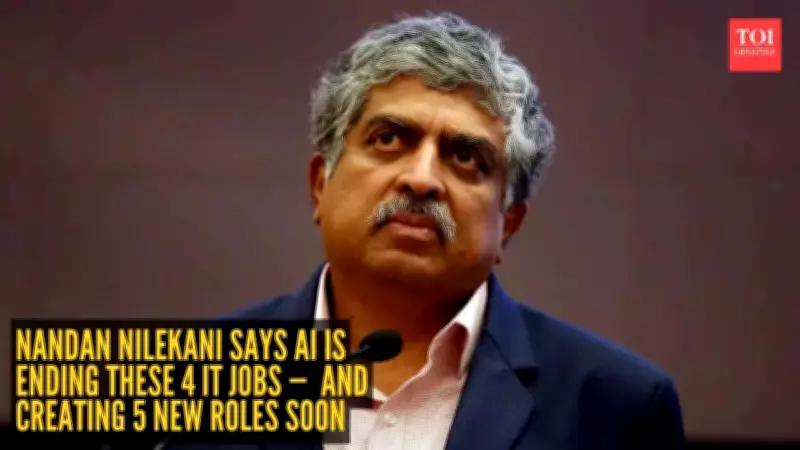
Imagine waking up one day to discover that the core of your professional expertise—such as meticulously crafting lines of code—has fundamentally shifted to an entirely new paradigm, like managing intelligent AI agents to accomplish tasks. This is the future envisioned by Nandan Nilekani, co-founder and chairman of Infosys, during the company's Investor Day 2026. Artificial intelligence is no longer merely a supplementary tool for IT professionals; it is igniting a profound, structural transformation in the daily responsibilities of technology workers.
The Root-and-Branch Transformation of IT Work
Nandan Nilekani emphasized that this shift is not a superficial adjustment, akin to installing a new application on a smartphone. He described it as a "root-and-branch" transformation, compelling organizations to completely rethink customer interactions, internal workflows, and team architectures. Unlike previous technological transitions to mobile or cloud computing, which could be integrated as additional layers, AI necessitates a comprehensive rewiring of systems and processes.
"Talent will have to deal with a world where writing code isn't the goal—it's making AI actually work," Nilekani stated plainly. This evolution demands that professionals acquire new skills in AI engineering, orchestrating AI agents—similar to coordinating a team of digital assistants—and navigating "non-deterministic" systems. In such systems, identical inputs may yield varying outputs, contrasting sharply with the predictable results of traditional software.

Jobs on the Decline and Emerging Opportunities
As AI automates routine and repetitive tasks, certain established IT roles are gradually fading into obsolescence. Nilekani highlighted four positions that are likely to diminish significantly in the near future:
- Front-end web developers: AI tools can now generate polished user interfaces within seconds.
- QA testers: Automation technologies detect bugs before human intervention becomes necessary.
- IT support specialists: Chatbots and self-healing systems manage routine technical fixes.
- Traditional blockchain roles: Broader AI platforms are absorbing niche tasks associated with blockchain technology.
However, this does not imply an immediate disappearance of these jobs. The nature of work is evolving as machines assume repetitive duties. On the positive side, exciting new IT roles are experiencing explosive growth in demand. These include:
- AI engineers: Professionals who build and fine-tune the underlying intelligence of AI systems.
- AI forensic analysts: Experts who debug malfunctioning AI, acting as digital detectives.
- Forward-deployed engineers: Specialists who embed AI directly into customer solutions.
- AI leads: Strategists who guide AI adoption across organizational teams.
- Data annotators: The often-overlooked contributors who label data to train more accurate AI models.
Nilekani articulated this shift bluntly: "Talent transformation is huge. It's not that you won't need people—it's that they'll shift from QA testing or basic development to these fresh roles like AI engineers, forward-deployed pros, leads, forensic analysts, and data experts." The critical challenge for companies lies in reskilling their existing workforce to thrive in this new environment. Human talent remains indispensable, but it will be directed toward different, more complex challenges.
The Legacy Trap: The Real Battleground for AI Implementation
Herein lies a significant complication. While there is considerable enthusiasm about AI generating new code for innovative projects—referred to as "greenfield" initiatives by Nilekani—the reality is more daunting. "Writing greenfield is not a big deal," he noted, pointing out that modern tools facilitate rapid code generation.

Nevertheless, most corporations are burdened by trillions of dollars invested in "brownfield" legacy systems. These outdated infrastructures are plagued by technical debt, data trapped in isolated silos, and undocumented peculiarities that only a few aging experts can decipher. Modernizing these legacy systems represents a formidable challenge—comparable to renovating a dilapidated house while it remains occupied, as opposed to constructing a new building from the ground up.
A Reality Check: Discipline Over Hype in AI Deployment
Nilekani issued a crucial warning against the unchecked hype surrounding AI. Merely because AI can generate content does not guarantee its utility. "You can generate stuff, which means you can generate slop," he cautioned. Without rigorous guidelines, quality assurance protocols, and demands for explainability—ensuring clarity on why AI makes specific decisions—organizations risk being inundated with substandard output that appears productive but delivers negligible value.
Although AI technology is advancing rapidly, with models becoming increasingly sophisticated, deployment lags behind. The primary obstacle is organizational complexity. Success hinges on comprehensive overhauls: revamping business processes, retraining teams, dismantling data silos, and fostering genuine cultural change. When executed correctly, AI unlocks substantial efficiencies and innovations. However, if mismanaged, it degenerates into costly and ineffective noise.