Code and coding are no longer moving in tandem, and this gap lies at the heart of artificial intelligence's disruption of the software services industry. Former Cognizant CEO Francisco D'Souza described this phenomenon as a form of cognitive arbitrage, where labor is increasingly replaced by machines. In a recent interaction with TOI, he highlighted the striking paradox that defines the current technological landscape.
The Great Decoupling
D'Souza, who founded tech investment firm Recognize a few years ago, has raised $1.7 billion for its second fund, just four years after closing its $1.3 billion debut. The firm focuses on companies valued between $50 million and $500 million, leveraging a partnership-driven model to accelerate growth. In his white paper, D'Souza describes this shift as the 'great decoupling,' where the value of code is rising sharply even as the act of coding becomes increasingly commoditized.
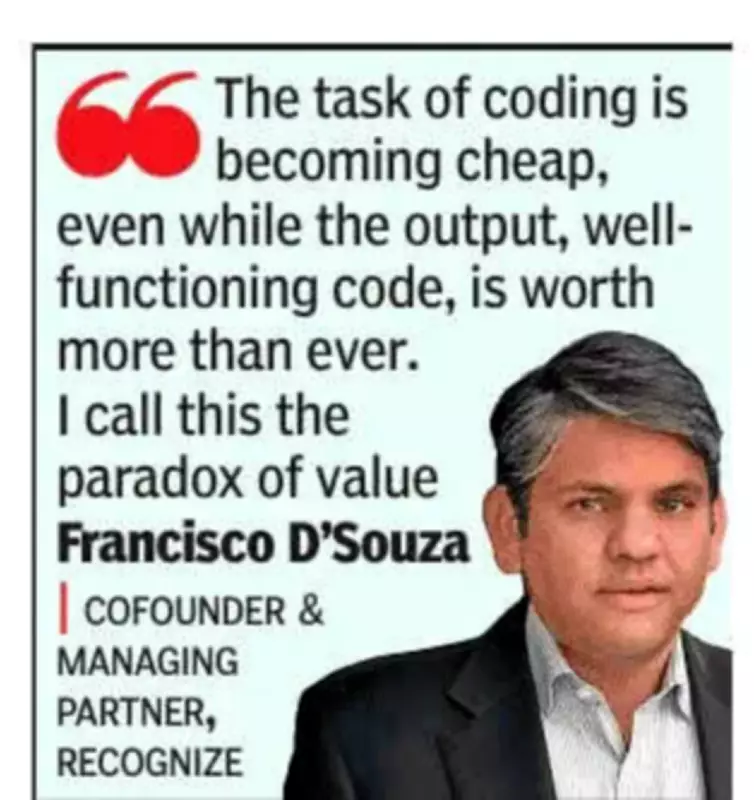
This creates a striking paradox. On one hand, the value of code has never been higher, evident in the extraordinary valuations of companies like OpenAI and Anthropic, driven largely by software. On the other hand, the value of coding—the act of writing code—is trending toward zero, as machines generate code at near-zero marginal cost. 'The task of coding is becoming cheap, even while the output, well-functioning code, is worth more than ever. I call this the paradox of value,' he wrote.

Challenges and New Models
However, abundant code does not equal reliable software. 'More code increases complexity, risk, and accountability challenges,' D'Souza said, arguing that firms must rethink commercial models. 'Input pricing is time-and-materials. Output pricing could be charged per member per month. The industry has tried outcome pricing before, but it is hard to measure and attribute. Output pricing is a good middle ground—it lets you capture productivity gains while aligning with customer value.'
Capturing this shift will require firms to move beyond legacy metrics and rethink how they create and deliver value. It also demands a different workforce. Upstream roles include value orchestrators, who align builds with business strategy; enterprise architects, who ensure integration with complex systems; and intent curators, who translate business needs into precise AI-executable specifications. Downstream roles like results orchestrators ensure AI-generated components come together into reliable outcomes; ethics stewards embed safety and guardrails; and accountability stewards own the output, bridging the 'certainty gap' when things go wrong.
J-Curve Effect
This transition, D'Souza said, will come with a J-curve effect. 'In the short term, productivity gains from AI will reduce the need for certain types of work, creating deflationary pressure. But over time, new types of work will emerge—driven by increased technology adoption and new market opportunities.'
The article was written by Shilpa Phadnis, an Editor (IT) and Business Journalist with over 15 years of experience covering IT, business, and startups, capturing the city's dynamic entrepreneurial ecosystem, GCCs, and new-age firms.