10 Unexplained Mysteries Hidden Beneath the Ocean Floor That Puzzle Scientists
Our oceans cover more than 70 percent of Earth's surface, yet their deepest realms remain one of humanity's most enigmatic frontiers. Beneath thousands of meters of water and immense pressure lie geological anomalies, biological marvels, and historical puzzles that challenge our current scientific understanding. Specialized research journals and government archives offer glimpses into these submerged landscapes where nature and history intertwine in mysterious ways.
The Immortal Jellyfish
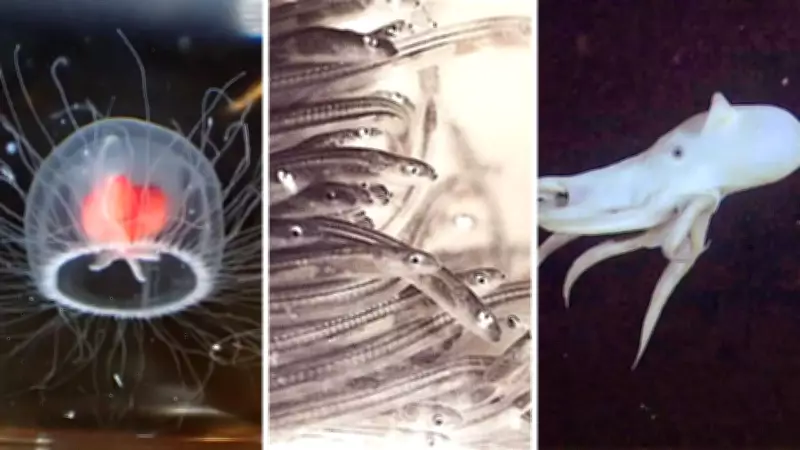
Scientific research published in the International Journal of Research in Engineering and Science reveals that Turritopsis dohrnii possesses biological immortality. This remarkable organism employs a process called transdifferentiation to revert from a fully developed adult medusa back to its earlier colonial polyp stage when facing stress or injury. By returning to this juvenile state, the jellyfish effectively escapes death, allowing it to restart its life cycle repeatedly—provided it avoids predation or disease.
The Fate of the SS Waratah
According to records from the State Library of South Australia, the SS Waratah vanished off the African coast near Durban on July 27, 1909, during a voyage from Durban to Cape Town with 211 people aboard. Contemporary investigations suggest the vessel likely capsized due to rolling effects from ocean topography or experienced a catastrophic explosion in its coal bunker. Despite extensive sonar mapping of the Agulhas Current region, no physical wreckage has been conclusively identified, leaving this maritime mystery unresolved.

The Migration of European Eels
European eels undertake an extraordinary migration to the Sargasso Sea, undergoing a complex metamorphosis known as silvering that prepares them for their thousand-kilometer journey from freshwater rivers to deep ocean spawning grounds. While scientists understand their destination and basic migration patterns, the precise navigational cues these eels use to traverse the vast, dark ocean depths remain a significant biological puzzle.
The Mariana Trench's Unexplored Depths
Reports from the British Geological Survey indicate the Mariana Trench comprises five distinct hadal zones separated by topographic high areas. Each zone varies in depth and hosts unique fish species found nowhere else. These zones have experienced limited genetic exchange due to their isolation, resulting in high levels of endemism, divergent evolutionary paths, and specialized biogeochemical processes that continue to intrigue researchers.
The Origin of the Bimini Road
Research from multiple universities identifies the Bimini Road as a natural beachrock formation. Carbon dating of carbonate-cemented shell material suggests these blocks formed approximately 2,800 years ago. Geologists supporting this view argue the road-like appearance results from natural coastal erosion and rock jointing processes over time, dismissing claims of human-made structures as scientifically inaccurate.
The Oceanic Nitrous Oxide Surges
Studies featured in Biogeosciences highlight the ocean as a significant source of nitrous oxide, a potent greenhouse gas. The sea surface microlayer shows elevated concentrations due to microbial nitrification and denitrification processes. Recent findings suggest phytoplankton blooms and photochemodenitrification may also contribute to increased nitrogen oxide levels, though the relative importance of these mechanisms remains poorly understood.
The Behavior of Dumbo Octopus
The MarineBio Conservation Society reports that Grimpoteuthis, commonly called Dumbo octopuses, inhabit extreme depths between 3,000 and 4,000 meters. Unlike other cephalopods, these creatures lack ink sacs and primarily use ear-like fins for locomotion. They employ unique pumping movements and umbrella-style floating techniques to drift through the water column. Their reproductive behavior also distinguishes them, as they deposit individual eggs directly onto the seabed rather than in clusters.

The Location of San José's Sunken Treasure
To prevent looting, the Colombian government maintains strict secrecy regarding the exact location of the San José galleon, which sank near Cartagena in 1708 at approximately 600 meters depth. The vessel reportedly contains substantial quantities of gold and emeralds. Ongoing legal disputes between Colombia, Spain, and various recovery companies continue over ownership rights to what many consider the Holy Grail of shipwrecks.
The Yonaguni Monument's Purpose
The Yonaguni Monument is a massive submerged sandstone formation off Japan's coast. Some enthusiasts point to its rectangular steps and pillars as evidence of a lost civilization, while most geologists attribute these features to natural processes. They suggest tectonic shifting and sedimentary rock erosion over millions of years created the monument's distinctive rectilinear formations through entirely natural means.
The Disappearance of the Mary Celeste
Analysis by EBSCO Research Starters details how the Mary Celeste was discovered drifting near the Azores in 1872 with no lifeboat but all cargo intact. New theories attempt to explain why Captain Briggs ordered evacuation despite no signs of violence aboard. One prominent hypothesis suggests leaking alcohol vapors created conditions the captain might have misinterpreted as an imminent explosion, prompting a rapid but orderly abandonment of the vessel.