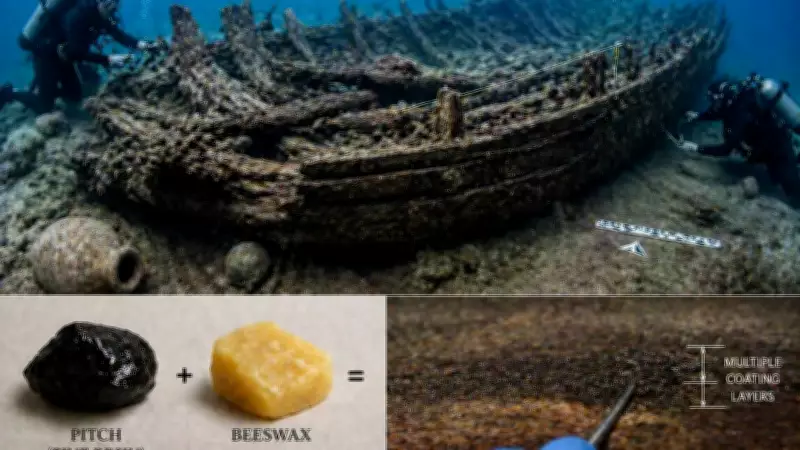
On the coast of Croatia, a Roman-era shipwreck has provided archaeologists with remarkable insight into how ancient ships were constructed and maintained to endure long journeys at sea. The shipwreck, known as Ilovik–Paržine 1, dates back approximately 2,200 years, offering a valuable resource for studying Roman shipbuilding strategies for maritime trade.
Previous research focused primarily on creating sturdy wooden vessels, often overlooking non-wood materials and coatings used to protect ships from seawater, decay, and marine life. This new discovery highlights the use of natural products like pitch and beeswax.
How Pitch and Beeswax Protected Ancient Roman Ships
Ancient shipbuilders used natural products to safeguard vessels from harsh sea conditions. Pitch, a viscous substance obtained by boiling conifer resin, was a key component. According to the study published in Frontiers, titled “Adhesive coatings in naval archaeology: molecular and palynological investigations on materials from the Roman Republican wreck Ilovik–Paržine 1 (Croatia),” the coating consisted mainly of pine resin pitch, sometimes mixed with beeswax for better elasticity and workability.

Ancient Ship Repair System Revealed Through Multiple Coating Layers
The boat was repaired several times throughout its life. Scientists discovered four to five coats of paint on different sections, indicating maintenance at various occasions and possibly different locations. This suggests Roman boats were serviced regularly within a systematic repair process to extend their longevity.
Pollen Analysis Reveals Roman Trade Routes and Repair Locations
Pollen trapped in the coating substance provided significant insights. Because pitch is sticky, it preserved pollen grains from the surrounding environment. Analysis revealed landscapes such as Mediterranean forests and coastal areas, indicating the ship may have been repaired at several locations around the Adriatic Sea.
Why the Roman Shipwreck Survived for Over Two Millennia
The shipwreck’s preservation depended on the underwater environment. When the ship sank, it partially buried beneath sediments, limiting oxygen exposure. This reduced bacterial activity on organic materials, helping conserve the ship in good condition even after approximately 2,000 years.
What This Roman Shipwreck Reveals About Ancient Maritime Technology
This discovery proves that Roman ship construction involved more than building wooden boats. It included waterproofing materials, an understanding of chemical formulas, and regular repairs. The mixture of pitch and beeswax, along with multiple coatings, demonstrates the knowledge that enabled ship durability. The wreck offers insights into the ancient maritime system, showing that durable ships were built through effective design and frequent repairs.