

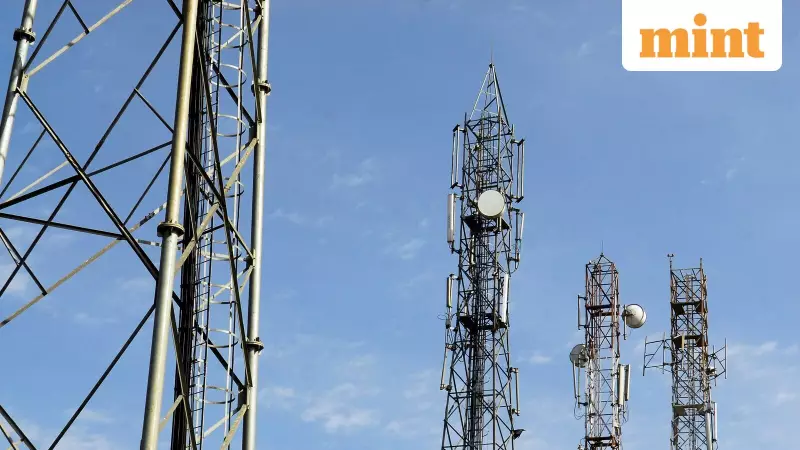
Emergency Response Upgrade Hits Spectrum Roadblock
India's critical ₹20,000 crore plan to revolutionize emergency communications has encountered a significant obstacle. A quiet but intense disagreement within the government over valuable radio spectrum threatens to delay the modernization of public safety networks.
The Core Conflict: Who Gets the 700 MHz Band?
At the center of this dispute lies the highly sought-after 700 MHz spectrum band. This particular frequency range offers exceptional coverage capabilities. Signals travel longer distances and penetrate buildings more effectively than higher-frequency alternatives.
The Home Ministry's Directorate of Coordination Police Wireless (DCPW) urgently wants this spectrum for police and disaster-response operations. They argue that a mature device ecosystem and lower deployment costs make it ideal for their needs.

However, the Department of Telecommunications (DoT) presents a different perspective. Officials state that the 700 MHz band is already fully allocated and cannot be reassigned at this time.
Why Modern Emergency Networks Matter
Current communication systems used by police, fire departments, and medical teams across India suffer from serious limitations. Most operate on aging analog technology or fragmented narrow-band networks.
These legacy systems primarily support voice communication only. They often function in isolation, preventing different agencies from coordinating effectively during crises.
Modern emergency response demands much more. Today's situations require high-bandwidth capabilities for:
- Real-time video analytics
- High-quality image transmission
- Advanced mapping and location services
- Integration of drones and IoT devices
- Artificial intelligence applications
Existing infrastructure simply cannot handle these technological requirements.
The Spectrum Allocation Challenge
Government documents reveal that the entire 45 MHz of spectrum in the 700 MHz band has already been distributed. Major allocations include:
- 10 MHz for the Defence Ministry
- 10 MHz for Indian Railways
- 5 MHz for NCRTC's rapid transit system
- 10 MHz for BSNL
Reliance Jio previously acquired 10 MHz worth ₹40,000 crore during 2022 auctions. Based on those prices, the 10 MHz spectrum sought by the Home Ministry carries an estimated value of ₹40,000 crore.
The National Frequency Allocation Plan 2025 has designated portions of the 800 MHz band for public protection and disaster relief networks. This allocation supplements previously assigned spectrum in the 400 MHz band.
International Precedents and Indian Delays
Globally, both 700 MHz and 800 MHz bands have emerged as preferred choices for public safety networks. The United States developed its FirstNet system on 700 MHz spectrum through a partnership with AT&T, a process that took approximately ten years.
Several European nations including France, Germany, and Switzerland have earmarked 700 MHz for similar purposes. South Korea and Thailand have allocated portions of both 700 MHz and 800 MHz bands for their emergency networks.
In India, progress has been notably slow. The Telecom Regulatory Authority first recommended establishing a pan-India broadband public safety network back in 2018. The regulator specifically called for dedicated, no-cost spectrum in the 800 MHz band to ensure rigorous safety standards.
Potential Solutions and Industry Interest
One government official suggested alternative approaches. "The Home Ministry could approach telecom service providers for priority service," they stated. "Alternatively, they could plan the public protection upgrade using the 800 MHz band."
Telecom operators see significant opportunity in this project. During recent earnings calls, Reliance Jio confirmed it is working with government agencies on public protection and disaster recovery initiatives. Other operators have expressed similar interest.
The government is currently seeking project management and technical consultants to assist with proof-of-concept trials across ten states. Although three consultants were shortlisted last year, officials indicate that fresh bids will be invited to encourage broader participation.

Bharat Bhatia, president of ITU-APT Foundation of India, emphasized the execution challenge. "Allocation of frequency is not the main issue," he explained. "The real task involves coordinating between telecom operators, state police forces, and various public safety agencies."
This coordination complexity, combined with the spectrum allocation dispute, continues to slow India's emergency network modernization. The delay raises important questions about resource prioritization when public safety hangs in the balance.





