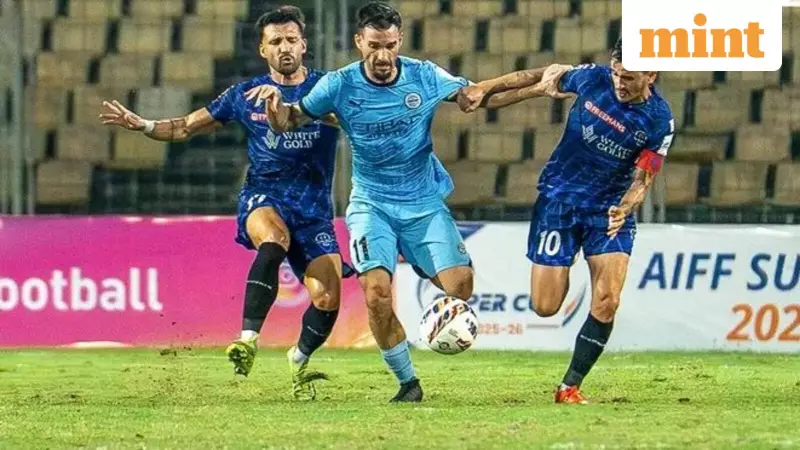
In a dramatic intervention that offers a lifeline to Indian football, the central government has pledged to the Supreme Court that it will take necessary steps to ensure the Indian Super League (ISL) 2025-26 season takes place. This assurance comes amid a severe financial and administrative crisis that pushed the nation's premier football competition to the brink of collapse.
Government's Crucial Assurance
Solicitor General Tushar Mehta informed a Supreme Court bench comprising Justices P.S. Narasimha and Joymalya Bagchi on Friday that the government would intervene directly to save the upcoming football season. The crisis emerged after the All India Football Federation (AIFF) failed to receive even a single bid for the ISL's 15-year commercial and media rights contract, putting the entire ₹450 crore tournament in jeopardy.
"I have spoken to the minister concerned. He is fully aware of the situation and has assured me that the league must be held. How it is to be financed, who the sponsors are, and other modalities can be left to the government," Mehta told the court.

Roots of the Crisis
The current emergency stems from the expiration of the 15-year Master Rights Agreement between AIFF and Reliance Industries' Football Sports Development Ltd (FSDL), which ends on 8 December 2025. Although FSDL had agreed to relinquish its rights, a fresh tender issued on 16 October by a Supreme Court-appointed committee headed by former Justice L. Nageswara Rao failed to attract any bids despite initial interest from four parties.
The four interested entities included FSDL, Dream Sports Group's streaming platform FanCode, real estate firm Conscient Group, and a foreign consortium. However, none submitted formal bids by the 7 November deadline, leaving the future of Indian football in complete limbo.
According to club petitions reviewed by media, the primary reason for the failed tender was the new AIFF Constitution, which grants the federation sweeping control over all competitions and "primacy" over key decisions. This arrangement would leave any commercial partner with minimal say in how their investment is utilized, making the league commercially unviable.
Football Pyramid on the Brink
The crisis has sent shockwaves throughout Indian football's entire ecosystem. Twelve ISL clubs moved the Supreme Court warning that the entire football pyramid—including the ISL, I-League, youth leagues, and women's football—faces imminent shutdown.
Indian football has effectively reached a standstill with multiple critical operations frozen. Player registrations and transfers under FIFA windows cannot proceed, pre-season camps have been derailed, travel and logistics arrangements have stalled, and sponsorship and broadcast discussions have completely stopped. Several clubs have already suspended operations as their revenue streams have dried up.
Justice Rao's committee report confirmed that despite extensive discussions with potential bidders, none of the four interested parties ultimately submitted bids. The committee has since sought feedback to understand why the tender process failed so completely.
Expert Warnings and Future Concerns
Rahul Mehra, the lead petitioner in the long-running football governance case, welcomed the government's intervention but cautioned against excessive state control over the tender framework. "In my understanding, the government should only look into conducting this year's ISL through its own good offices, such as sponsors and broadcasters, and nothing more," he stated.
Mehra emphasized that a fresh tender should be floated later by the Justice Rao-led committee and warned that rushing the next tender "at a depressed value under the garb of urgency" would prove damaging for both Indian football and its players.
The expert also highlighted the need for the AIFF to obtain an independent, scientific valuation of Indian football before floating a new tender and to guard against cartelization. Most critically, Mehra warned that excessive government involvement in finalizing commercial arrangements could invite sanctions from FIFA for third-party interference—a scenario India experienced firsthand during its 2022 suspension for similar issues.

The AIFF did not respond to media queries about the developing crisis. The situation represents perhaps the most significant challenge Indian football has faced since the ISL's inception, which has seen the league grow from eight clubs in 2013 to fourteen today under FSDL's management, which guaranteed AIFF an annual fee of $5.1 million.
As the football community holds its breath, the government's intervention offers hope that the beautiful game in India might yet be saved from complete collapse.