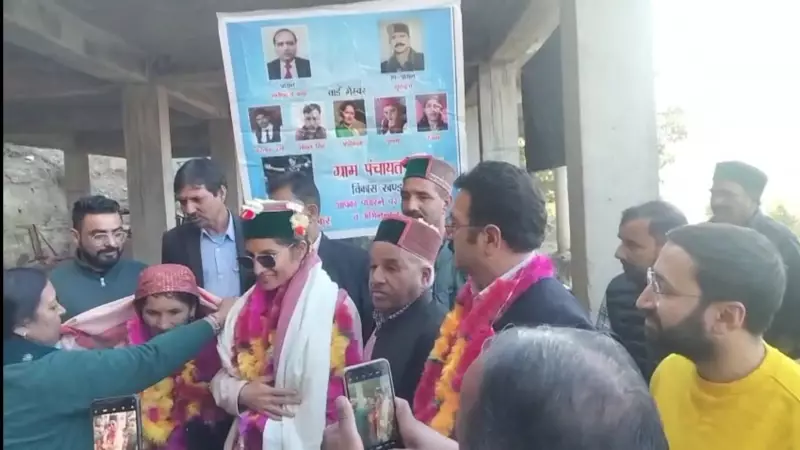
The unprecedented success of Indian women's cricket team pacer Renuka Singh Thakur has helped her native village of Parsa in Himachal Pradesh reclaim its lost glory and pride. The village elders see in Renuka's achievements a revival of the same physical prowess that once made their community famous throughout the Mahasu region for dominating traditional tug-of-war competitions.
From Rassa-Kassi Champions to Cricket Glory
There was a time when the entire region would celebrate the unmatched physical strength of Parsa people, particularly the men who would consistently win the 'rassa-kassi' (tug-of-war) competition held at the Rohru fair every April. Renuka claimed three wickets in six matches during the Women's World Cup, but her impact extends far beyond cricket statistics.
"The way Renuka is being appreciated and welcomed gives us a feeling of déjà vu," said Parsa pradhan Ganesh Dutt Sharma (75). "Decades ago, our men were unbeatable in the rassa-kassi competition across the entire Mahasu region, which now includes Shimla, Solan and large parts of Sirmaur district."

The 75-year-old retired chief administrative officer at Shimla district courts added that the competition was eventually dropped from the fair, only to be reintroduced recently but exclusively for women. He noted a beautiful parallel in traditions: After India's victory in the Women's World Cup, Renuka visited all local shrines, just as the village players used to do after winning the rassa-kassi competitions.
Ancestral Strength Runs in the Family
Sharma revealed fascinating connections between Renuka's current athletic prowess and her family heritage. "I had heard much about the physical endurance of Renuka's grandfather Parmanand Thakur, but I personally witnessed the strength of one of her uncles Thakur Kamla Nand, who would pull the rope either from the front or the end during the competition," he shared.
He expressed certainty that Renuka draws her immense physical strength from her ancestors, emphasizing how the village's fame has expanded globally through her achievements. "Earlier, Parsa was famous only in the region, but now its daughter has put it on the world map," Sharma stated emotionally.
Purshotama Devi Sharma, Pradhan of the village Mahila Mandal (Women's Circle), acknowledged that while the women's team from Parsa participates in the rassa-kassi at Rohru fair, they haven't yet achieved the same glory the village men once enjoyed. "We regret that, but this girl, Renuka Singh Thakur, has filled that void. We are proud of our daughter," she declared.
Village Celebrations and Future Aspirations
After winning the World Cup, Renuka visited Parsa on Sunday amid a rousing welcome by villagers. Renuka, along with her mother Sunita Thakur and brother Vinod, first visited the Hatkoti temple, continuing the tradition of paying respects at local shrines after significant victories. On Monday, the family offered prayers at Mahasu Devta Temple at Hanol in Uttarakhand.
Renuka's uncle Bhupinder Thakur, who first identified her talent and sent her to a women's cricket academy in Dharamshala, provided insight into the family's physical capabilities. "Her physical strength is genetic. Our family belongs to a martial community. My father was known for his exceptional strength in the region," he explained.
Bhupinder, who serves as Principal of a Degree College in Theog and is also a volleyball coach and international referee, highlighted the village's need for better sports infrastructure. Parsa residents have demanded adequate playgrounds for children to nurture their sporting talent, noting that the tough and rugged topography of Himachal Pradesh leaves little scope for large playgrounds in most parts of the state.
The village of approximately 81 households, now an independent panchayat after previously being under Lower Koti Gram Panchayat, largely comprises Rajput and Brahmin families. Renuka's personal story adds to her remarkable journey - she lost her father, Kehar Singh Thakur, an employee of the Irrigation and Public Health Department, when she was just three years old. Her brother and she were raised single-handedly by their mother, who later secured a compensatory appointment in the IPH Department.

Prime Minister Narendra Modi recently praised Renuka's mother for raising her single-handedly when members of the Indian Women's Cricket Team called on him in New Delhi after winning the ICC Women's World Cup on November 7. The village now celebrates not just a cricket star, but a daughter who has connected their proud past with a glorious present.