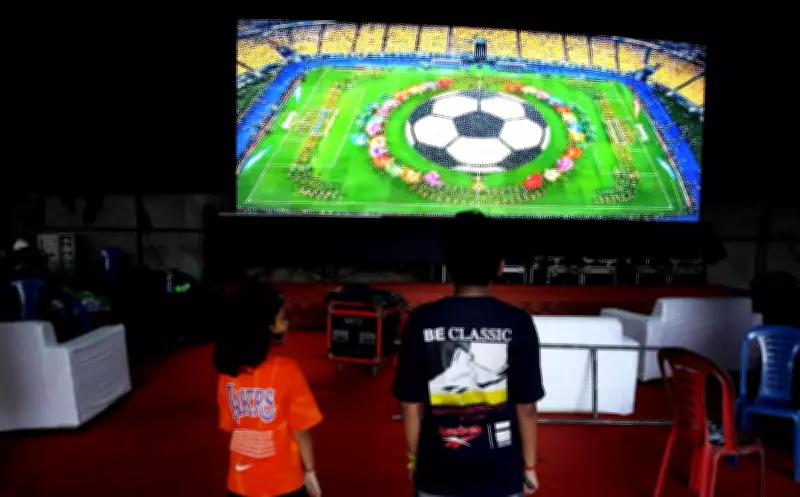
Kochi: The screening partnerships announced by Zee Entertainment, the official broadcaster of the FIFA World Cup 2026 in India, have raised questions over Kerala’s long-standing tradition of neighbourhood match screenings. A statement by Kochi-based Eagles FC claiming exclusive public-viewing rights for Kerala and Mahe from ZEEL has left local organisers unsure whether they need licences to screen matches.
Besides Eagles FC, ZEEL has tied up with Novex Communications, Zion Bridge and What’s Up Goa to facilitate official public-viewing events. Eagles FC plans FIFA World Cup 2026 Fan Parks in all 14 districts, including seven in Malappuram, to livestream the semi-finals, third-place play-off and final on giant LED screens.
The club said organisations, clubs, commercial establishments, local bodies and even non-commercial groups intending to hold public screenings in Kerala and Mahe must obtain a public-viewing licence. The licence fee for the entire tournament is understood to be around Rs 25,000.

The announcement has unsettled local football groups, which have traditionally organised low-budget screenings at junctions, grounds and club premises using borrowed or rented LCD screens. “There is still no clarity on the licence structure. We regularly organise World Cup screenings, but the demand for a licence is new,” said Saeed Fasal, who organised screenings in previous tournaments.
Many organisers hope the requirement applies only to large commercial events. “There could be thousands of screenings in Malappuram district alone. It won’t be easy to monitor all of them,” he said.
Concerns have grown because Eagles’ statement defines “public viewing” broadly to include events hosted by non-commercial organisations, fan clubs, local associations and even residential societies and neighbourhood groups.
Eagles chairman Shaffi Mather said the initiative was aimed at providing fans with a legal and enhanced viewing experience. However, he did not clarify whether small neighbourhood screenings would also require licences, saying only that the fee would be modest, “equivalent to a two-day LCD screen rental.”
The uncertainty is especially significant in Malabar, where World Cup nights transform towns and villages into open-air football arenas. Unofficial estimates suggest nearly 1,500 public screenings in Malappuram alone, with similar enthusiasm in Kozhikode, Palakkad and Kasaragod.
While Kochi has embraced organised fan parks, Malabar’s football culture remains rooted in informal, community-led celebrations. “These gatherings are about more than football. They bring people together across age, class and locality,” Fasal said.