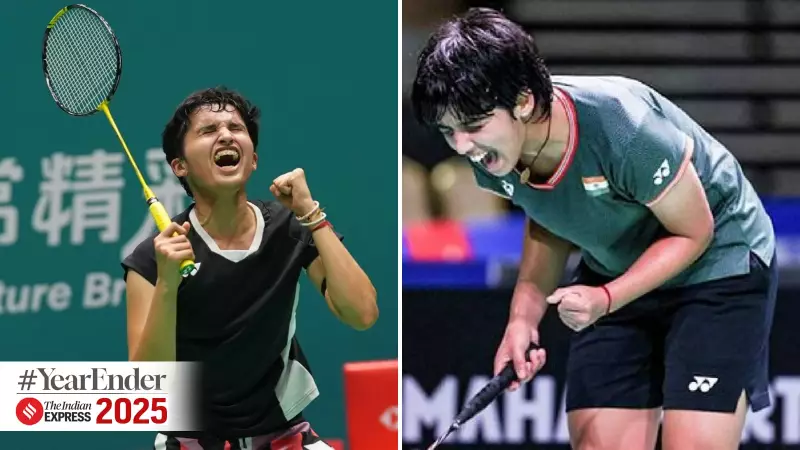
The year 2025 witnessed a powerful surge from India's young sportswomen across disciplines. From the ice-cool control of Sree Charani to the relentless grit of Sheetal Devi, and from chess prodigy Divya Deshmukh to shooter Suruchi Phogat, a new generation, dubbed 'Gen She', kept the Tricolour flying high. In badminton, this charge is being led by two promising talents: Unnati Hooda and Tanvi Sharma. While they may not possess the natural physical gifts of a PV Sindhu, they are quietly and determinedly plotting their journeys towards the sport's upper echelons.
The Milestone Victory & The Mental Edge
For 18-year-old Unnati Hooda, 2025 was marked by a significant career milestone. In June, she defeated the legendary PV Sindhu at the China Open, a Super 1000 event. By December 15, her consistent performances had propelled her to a career-high World No. 23 ranking. While several Indian players have held the No. 2 spot behind Sindhu, Unnati's win carried a deeper psychological weight. It was a statement of intent, akin to a boxer challenging for a heavyweight title.
Unnati executed a specific plan against the former World No. 2 with fearless humility. Her post-match reflection was telling: while respectful of Sindhu's stature, she pointedly noted there were "bigger fish to fry from around the world." This mindset underscores a shift. However, experts caution that India is not about to luck into a seamless transition like the Saina-Sindhu handover of a decade ago. For both Unnati and 17-year-old Tanvi Sharma, 2025 was promising, but a true breakthrough year is still some distance away.

The Daunting Questions for 2026
The coming year will pose straight-up questions for the duo. The most pressing: Can they make the jump from the Top 25 to the elite Top 10 without the innate power and reach that defined Sindhu's game? Furthermore, can they ascend to the Saina-Sindhu stratosphere without the direct guidance of coach Pullela Gopichand, the architect of India's modern badminton success?
Tanvi Sharma, an above-average stroke-player, has shown she belongs with the exceptional talents of her age globally, reaching finals at the US Open and World Juniors. Yet, she herself has identified gaps. After losses to Chinese and Thai opponents, she noted, "we lack in physical strength, and aren't mentally as strong." The challenge for her coaches, including Park Tae-sang, is to build a game of exceptional deception or explosive agility to compensate for not matching Sindhu's physical template.
Unnati possesses an X-factor on her accurate, attacking days and has the nerve to capitalise on an opponent's off-day. World champion Akane Yamaguchi has warned that Unnati can take unsuspecting rivals by surprise. However, she is also error-prone and has been resistant to seeking professional training beyond her father's coaching, needing a more robust setup to maximise her potential.
Fitness: The Non-Negotiable Queen
The universal truth in women's singles, one that Gopichand himself would emphasise, is that fitness is paramount. An array of strokes and tactical nous are merely basic requirements. The modern game, dominated by athletes from China, Japan, Korea, and Taiwan, is built on a foundation of excruciating strength and conditioning drills.
Both Tanvi and Unnati have shown a tendency to fade in the second half of games against Top 10 opponents and are often washed out in deciders. PV Sindhu's performance in the 2017 World Championship final remains the gold standard of fitness and endurance. To compete consistently at the highest level, the young duo must assume their opponents are physical powerhouses and train accordingly. Their mental strength will be drawn directly from this fitness base.
The trajectory of the next few years will depend almost entirely on how Unnati Hooda and Tanvi Sharma progress physically. Their technical games hold promise. One of them might well represent India at the 2028 Los Angeles Olympics. As Unnati wisely stated after her win over Sindhu, "I need to beat all top players in the world, not just Sindhu." It is a formidable task, but 2025 proved they have the audacity to begin plotting the course.