CBSE Mandates Full School Cooperation for National Foundational Learning Study 2026
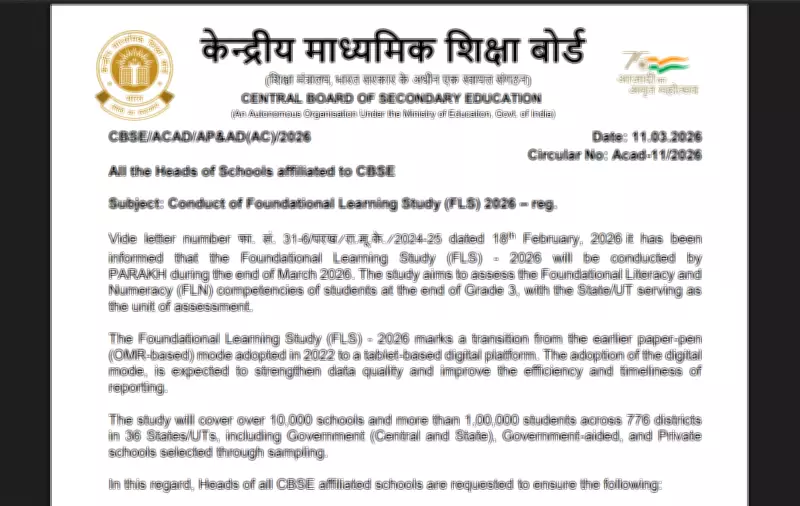
The Central Board of Secondary Education (CBSE) has issued a formal directive to all its affiliated schools across India, instructing them to extend complete and unwavering cooperation for the upcoming Foundational Learning Study (FLS) 2026. This critical nationwide assessment is specifically designed to evaluate the foundational literacy and numeracy skills of students who have completed Grade 3.
Official Directive and Study Framework
According to an official communication released on February 18, 2026, the comprehensive study will be conducted towards the end of March 2026. The assessment will be executed by PARAKH (Performance Assessment, Review, and Analysis of Knowledge for Holistic Development), operating under the esteemed aegis of the National Council of Educational Research and Training (NCERT).
The assessment framework is strategically designed with States and Union Territories serving as the primary unit of analysis. This approach will empower policymakers and education authorities to conduct meaningful comparisons of foundational learning levels across different regions. The resulting data is intended to facilitate the design of highly targeted and effective education interventions to bolster early-grade learning outcomes nationwide.

A Major Shift to Digital Assessment
One of the most significant and transformative modifications for FLS 2026 is the complete shift from traditional paper-based testing to a digital platform. Previous iterations of the assessment, such as the 2022 study, relied on paper-pen tests that were subsequently evaluated using Optical Mark Recognition (OMR) sheets.
This year marks a pivotal change in direction, as the entire test will be administered using tablets. Education officials and experts believe this transition to technology-intensive data collection will substantially enhance several key areas:
- Data Accuracy: Minimizing human error in data entry and collection.
- Speed of Analysis: Enabling faster processing and reporting of results.
- Overall Reliability: Improving the consistency and trustworthiness of the collected data.
The Immense Scale of the 2026 Assessment
The Foundational Learning Study 2026 is poised to be an assessment of remarkable scale and reach, encompassing a vast and representative sample of India's educational landscape.
The study will cover:
- More than 10,000 schools across the country.
- Over 1,00,000 Grade 3 students.
- 776 districts spanning all 36 States and Union Territories.
The sampled schools have been meticulously selected through a scientific sampling process to ensure the findings paint a truly representative national picture of foundational learning levels. This sample will include a diverse mix of institutions:
- Government schools run by central and state authorities.
- Government-aided schools.
- Private schools.
CBSE's Key Instructions for Schools
In its detailed communication, the CBSE has explicitly asked the heads of all affiliated schools to ensure two critical arrangements for the smooth and successful implementation of the study.
First, all sampled schools are mandated to remain open and fully operational on the pre-scheduled assessment dates. This is crucial to allow the evaluation teams to conduct the tests without any disruption or logistical hurdles.
Second, schools have been firmly instructed to extend full cooperation and necessary assistance to the assessment teams deployed to their premises for the duration of the exercise.
Multi-Level Coordination for Seamless Execution
The successful execution of such a large-scale study requires robust coordination at multiple administrative levels. The study will be technically guided at the national level by PARAKH at NCERT.

At the state and district levels, a collaborative network of several key institutions will manage the complex logistics and field implementation. These coordinating bodies include:
- Samagra Shiksha
- State Council of Educational Research and Training (SCERTs)
- State Institutes of Education (SIEs)
- District Institutes of Education and Training (DIETs)
- District Education Offices
This well-structured, collaborative framework is meticulously designed to ensure the smooth administration, efficient data collection, and effective monitoring of the Foundational Learning Study 2026 across the entire nation.