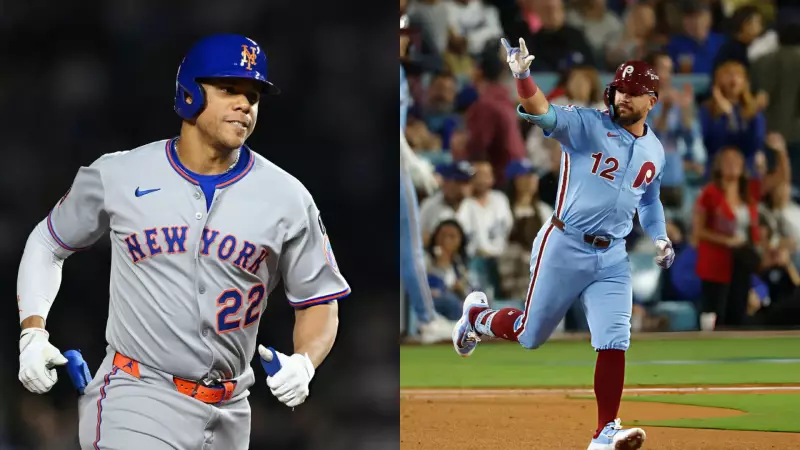
In the world of Major League Baseball, two sluggers, Juan Soto and Kyle Schwarber, are delivering powerful performances at the plate. However, a look at their financial standings reveals a starkly different picture, highlighting how modern baseball economics reward star power and marketability alongside pure athletic skill.
The Financial Dominance of Juan Soto
Juan Soto, the 27-year-old Dominican superstar nicknamed "Childish Bambino," has built an estimated net worth of $121.9 million. This fortune stems from a combination of historic contracts, signing bonuses, and lucrative endorsement deals. His financial journey reached a pinnacle on December 8, 2024, when he signed a record-shattering 15-year, $765 million contract with the New York Mets. This deal, orchestrated by Mets owner Steve Cohen, averages a staggering $51 million per year with no deferred payments.
Soto's path to this wealth involved strategic patience. As a free agent after stints with the Washington Nationals and San Diego Padres, he famously turned down two massive offers from the Nationals: a 13-year, $350 million extension in 2021 and a 15-year, $440 million offer in 2022, betting correctly on an even bigger payday.

According to financial tracking site Spotrac, his career earnings are projected to reach $204.5 million by 2026. This includes everything from the $1.5 million signing bonus he received as a 16-year-old international free agent in 2015 to his monumental Mets deal. In 2025 alone, Soto earned an estimated $126.9 million before taxes, with 95% coming from his contract, making him MLB's highest-paid player that year as confirmed by Forbes.
Beyond his salary, endorsement partnerships with giants like Nike and Pepsi significantly boost Soto's income, though exact figures are not public. His financial comfort was evident early when, in a 2021 interview, he disclosed using $200,000 from his All-Star and Home Run Derby winnings to sponsor Dominican Olympians.
Kyle Schwarber's Steady Salary Climb
In contrast, Kyle Schwarber, the 32-year-old power-hitting designated hitter, does not have a publicly confirmed net worth in major publications like Forbes as of January 2026. His financial story is almost entirely written through his MLB salaries. According to Spotrac, his career earnings reached $99.99 million through 2025 and are anticipated to hit around $130 million by the end of 2026.
Schwarber secured his major payday on December 9, 2025, re-signing with the Philadelphia Phillies on a five-year, $150 million contract. This deal, with an average annual value of $30 million, made him the highest-paid designated hitter in baseball, surpassing Giancarlo Stanton. Phillies manager Rob Thomson celebrated the move with a simple "Welcome back to the fam," underscoring Schwarber's value to the team's culture after four productive seasons.
His 2025 season was spectacular, featuring 56 home runs and 132 RBIs, which placed him second in MVP voting and attracted offers from other clubs like the Pittsburgh Pirates. However, he chose to stay loyal to Philadelphia, nearly doubling the value of his previous four-year, $79 million contract with the team. For the 2026 season, he will earn $30 million, split between a $15 million base salary and a $15 million signing bonus.
Unlike Soto, Schwarber's off-field endorsement portfolio is not widely documented or highlighted in reports, indicating his wealth accumulation is primarily driven by his consistent performance and salary earnings since his debut with the Chicago Cubs in 2015.
Marketability vs. Performance: The New MLB Equation
The financial narratives of Soto and Schwarber illustrate a critical shift in how value is assessed in contemporary baseball. While both are elite performers, Soto's significantly higher net worth underscores the premium placed on youth, global market appeal, and off-field brand building. His Dominican heritage, charismatic personality, and early career success have made him a magnet for corporate partnerships, amplifying his earnings beyond his already colossal salary.

Schwarber's trajectory, while incredibly lucrative, follows a more traditional path of earning power through sustained on-field excellence and key contract negotiations at peak performance periods. His story is one of resilience, from coming back from a severe knee injury in 2016 to help the Cubs win the World Series to becoming a central figure in the Phillies' lineup.
This comparison goes beyond two players' bank accounts. It reveals that in today's game, a player's financial ceiling is no longer determined solely by batting averages or home runs. Factors like age, marketability, and the ability to attract endorsements are now integral components of a superstar's economic profile, creating distinct pathways to wealth even among the sport's very best.