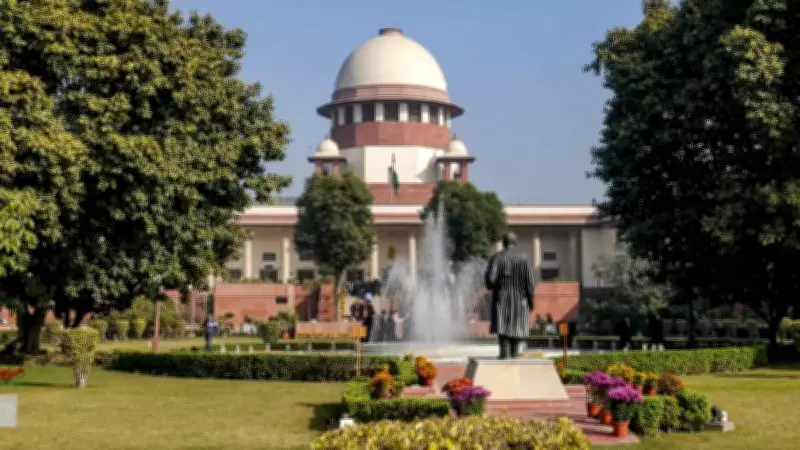
Supreme Court Issues Stern Warning on Court Order Compliance
The Supreme Court of India has delivered a powerful rebuke against litigants, particularly government authorities, who fail to comply with judicial orders and instead file appeals or review petitions only when faced with contempt proceedings. In a strongly worded judgment, the court emphasized that such practices must be dealt with harshly to prevent the erosion of public faith in the judiciary.
Bench Condemns Delayed Appeals and Non-Compliance
A bench comprising Justices Ahsanuddin Amanullah and R Mahadevan expressed deep concern over what they described as a troubling trend. "Delayed filing of appeals should be the exception. But in recent times, the exception has practically evolved to become the rule," the bench observed. The justices noted that court orders are frequently ignored for extended periods, and contempt petitions often trigger belated appeals filed with significant delays.
The court explicitly stated that administrative hurdles or claims of impossibility cannot be invoked as defenses in contempt proceedings if the contemner has failed to inform the court about implementation difficulties within the prescribed time limit. This clarification removes potential loopholes that might otherwise be exploited by non-compliant parties.
Potential for Criminal Contempt Charges
In particularly strong language, the bench suggested that such behavior might border on criminal contempt. "We, in no uncertain terms, deprecate these practices. It is felt that by such modus operandi, disobedient litigants act brazenly which has the further effect of bringing down the authority and majesty of courts and the rule of law, interfering in the administration of justice," the judgment stated.
The court emphasized that high courts should deal with "unscrupulous litigants, more so when they happen to be 'State', within the meaning of Article 12 of the Constitution, or like bodies, with an iron hand." This directive specifically targets government entities that might otherwise believe they can disregard judicial orders with impunity.
Broader Implications for Judicial Authority
The Supreme Court warned that unless higher courts address these issues firmly, there is a clear risk of erosion in the public's faith in the judiciary. "It is the solemn duty of all of us manning courts across the hierarchy to ensure that the public faith never wavers," the bench declared, highlighting the fundamental importance of maintaining judicial authority.
The judgment also expanded the scope of contempt proceedings, clarifying that liability would not be confined only to parties directly before the court. Third parties and non-parties involved in the decision-making chain would also be held accountable for non-implementation of court orders.
"Simply put, thus, it is no longer res integra that a party, once becomes or is made aware of an order of this court, if yet acts in wilful default or deliberate non-compliance or any such like conduct against/in breach of the order concerned, makes itself liable to face the full wrath of contempt jurisdiction," the court stated unequivocally.
Specific Case and Final Warning
The court issued these observations while hearing a contempt petition against Chhattisgarh government officials for failing to comply with an order regarding the regularization of employee services. In a final warning, the bench granted the officials one last chance to implement the order within fifteen days, demonstrating the practical application of their stern stance on compliance.
The judgment represents a significant strengthening of contempt jurisdiction and sends a clear message to all litigants, especially government bodies, about the serious consequences of disregarding judicial directives. The Supreme Court's position reflects growing concern about maintaining the rule of law and preserving the judiciary's authority in the face of increasing non-compliance with court orders.