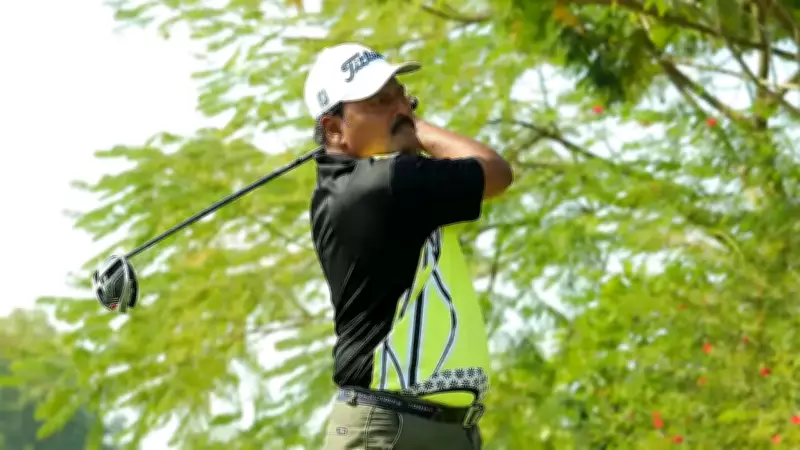
NEW DELHI: In the second half of the 1990s, Vijay Kumar became a familiar name in sports newsrooms, though few knew him personally. A colleague with roots in Lucknow would share how the golfer's father, a batman for the Railways assigned to his father, would ferry him to school on a bicycle, with young Vijay seated on the saddle of the central tube.
This anecdote provided a personal connection against the backdrop of a nascent professional golf scene in India. Vijay Kumar held a special sway over the Order of Merit, winning it for four straight years between 1995 and 2000. In a highly competitive field that included pioneers like Ali Sher and Rohtas Singh, and international crossovers like Daniel Chopra, Arjun Atwal, and Jeev Milkha (then Chiranjeev), Vijay Kumar of Lucknow was an extraordinary heavyweight.
Life in Martinpurva
Vijay Kumar lived and died in Martinpurva, an urban village on the north-eastern fringe of the Lucknow Golf Club, once the La Martiniere Golf Club, situated close to the Chief Minister's residence. As his appearances on the Indian tour became infrequent over the last decade-and-a-half, he seemed to enjoy relative anonymity, happy to run the pro-shop at the course and chip in with coaching. Located barely a golf ball's throw away from the course, Martinpurva's residents found occupation as greenkeepers, groundspersons, or better, caddying for club members.

This is the story of every Indian caddie-pro: coming from socially and economically backward sections of society, spending enough time on the course to know each blade of grass, picking up a hand-me-down club, and then turning professional. Vijay embodied the truest meaning of the idea of a 'professional golfer' — pursuing the sport as a livelihood, with the contest embedded within. He was what Rashid Khan calls a 'no option golfer'.
Perspectives from Fellow Golfers
Rashid Khan recalls, "Vijay uncle and many like him always ended up in the lead groups because there was no option. He had to win to keep his home running. We all have to do that." Pappan, a Delhi Golf Club fairway fakir, concurred: "If you looked closely at the final scoresheets of the big international tournaments in our time, you'd always find us hovering near the winner's list. That's because we needed to do well."
When asked why someone with such domination on the Indian Tour showed scant regard for playing regularly in Asia, Japan, or Europe, Vijay Kumar's constant response was, "Bahaar kyaa jaana, yahan jeet toh rehen hain..." (Why go abroad? Winning here is what matters). Perhaps it was the inherent inhibition born out of his class that stopped him. Vijay, a Rawat Pasi, would deflect further inquiries with a dismissive, "Amaa yaar, chai pilao..." (Oh friend, get me some tea) tossed over the shoulder.
A Visit to Martinpurwa
He played the perfect host when one visited him in Martinpurwa in 2002. It was after his Indian Open victory, and one hoped to get inside the head of Indian golf's silent powerhouse. But all one got were distant one-sentence replies. Approachable but famously reticent, Vijay Kumar was the unspoken alpha in his peer group in the 1990s and 2000s, traveling 'to work' huddled in unreserved train compartments, cohabiting six to a hall during the week.
A moment stands out in memory. Widely favoured to win the Indian Open in 1998, he had to miss it due to a wrist injury in the Pro Am. Four years later, as he walked in his inimitable amble to the 18th hole to complete a long-overdue triumph, his loving tribe followed, almost claiming his victory as their own. In the late afternoon sun of the Delhi Golf Club, it almost seemed he was floating on a thousand shoulders as he approached the final green.

His Unique Style and Legacy
He was only 57, but Vijay, heavyset in a way that wasn't slouchy and surprisingly sprightly only when he wanted to be, always seemed older. With his size, he wielded the club with a lightness and control as if it were sawed in half. Pappan remembers a 'dilaer' golfer: "He didn't know what pressure meant." It was either the winter of 1999 or 2000 at the Noida Golf Course. Somehow it went down to a play-off between Vijay and a golfer from Chandigarh. Watching, even we felt the nerves. But Vijay simply looked around, spotted a familiar face, and asked him for some tobacco. Mouth full, he said, "Pressure? Kya pressure, abhi toh mazaa shuru hua hai..." (Pressure? What pressure? The fun has just begun).
Vijay Kumar's story is a testament to the resilience and passion of Indian golfers who rose from humble beginnings to achieve greatness on their own terms.