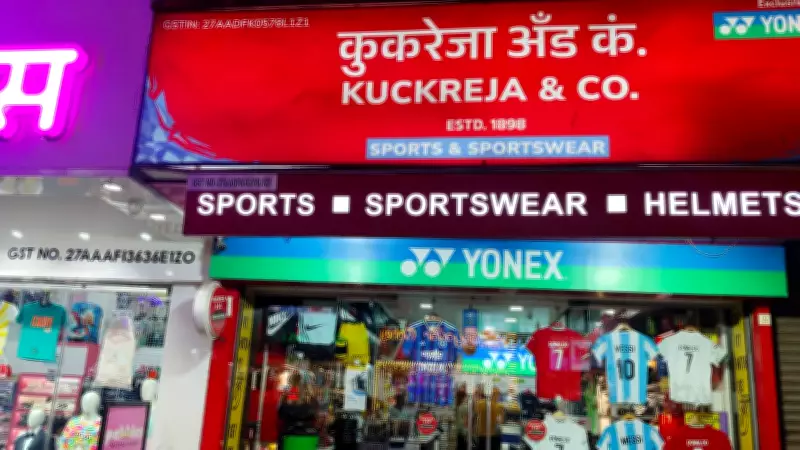
In the heart of Pune, nestled on MG Road in the Camp area, stands Kuckreja Sports, a store that has quietly nurtured 128 years of India's sporting evolution. As the nation approaches another inflection point in its sports culture, with women's participation accelerating and Indian athletes becoming regular features at Olympics and world championships, this establishment serves as both a witness and an active participant in this transformative journey.
A Legacy Born in 1898
The shop was established by Thakurdas Madan in 1898, with a singular mission: to make quality sports equipment accessible. "From the very beginning, we sold all kinds of equipment needed for sports like football, cricket, tennis, and badminton," says Vivek Madan, the 80-year-old third-generation owner. In the early 1900s, when these games were largely considered pursuits of the elite, Kuckreja operated as the primary retail haven for a small circle of enthusiasts.
Until the 1950s, it was practically the only place in Pune where one could purchase sports gear, naturally attracting all local sportspersons. The customer base during this era was predominantly composed of British officials, wealthy Indian maharajas, and government elites, reflecting a business thriving at the intersection of colonizer and colonized.

Expansion and Adaptation Post-Independence
Despite opportunities in manufacturing after independence, the Madan family chose to remain in retail, expanding their footprint across India with branches in cities like Solapur, Nagpur, and Bengaluru. In 1963, a parallel venture, Champion Sports, was established by Indranath and Satyapal Madan, complementing Kuckreja's legacy. Today, the family operates both branches in Pune, with the newest generation representing the fifth chapter of this enduring story.
The evolution of sports equipment has been dramatic. "In the early years, cricket bats, tennis rackets, and badminton equipment were crafted from pure wood, shaped by hand. Volleyballs, footballs, and basketballs were made from authentic leather with inner rubber tubes and leather laces for filling air," Madan recalls. Now, rubber-made balls with simple air holes have replaced these, though some vintage pieces still exist at Champion Sports.
Democratizing Sports Through Innovation
The 1970s and 1980s accelerated this transformation, with metal rackets replacing wooden ones and synthetic materials like carbon fiber entering the market. Madan emphasizes that this shift was not merely about replacing the old but about making sports accessible to everyone. "The transformation wasn't about replacing the old; it was about making the game accessible to everyone," he observes, highlighting how innovations democratized sports participation.
Until the mid-1960s, sports in schools and colleges remained niche, with girls' participation nearly non-existent. The 1982 Asian Games marked a turning point, transforming sports from a luxury to an aspirational necessity. Madan notes that Pune has consistently led in this regard, ranking among India's top cities for sports participation. "Pune's sports attitude has always been better than other cities. Now, boys and girls participate in large numbers, and we have the highest number of indoor badminton halls," he says.
Changing Mindsets and Modern Challenges
This evolution mirrors a shift in how people view sports equipment spending. Madan reflects on past conversations where women would prioritize buying silk sarees over sports gear due to cost. "That mindset has completely changed. Women and girls now buy sports equipment without hesitation, never compromising on quality," he states.
In an era dominated by e-commerce and discounting, Kuckreja's longevity offers lessons. Madan acknowledges that while legacy matters, quality and pricing are paramount. "Customers come back because of desirable quality and pricing. That is our USP," he asserts. The store has selectively embraced modern technology, investing in professional-grade electronic stringing machines for rackets and promptly adopting innovations like Yonex's latest releases.

Despite its resilience, Kuckreja has faced challenges, including a post-1947 decline and the COVID-19 pandemic, which saw sports participation plummet. Yet, through adaptability and a commitment to accessibility, this Pune institution continues to play a vital role in India's sporting narrative, proving that some legacies are built to endure.