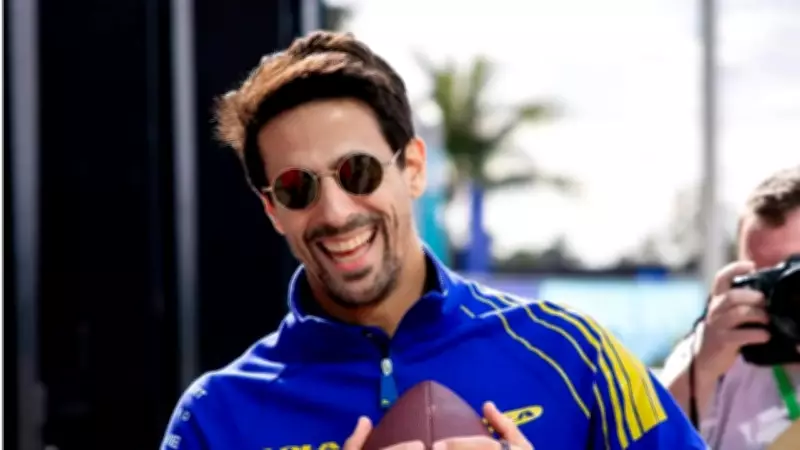
Lucas Di Grassi Analyzes Charles Leclerc's F1 Energy Management Challenge
Former Formula E champion Lucas Di Grassi has returned with another technical racing explanation, this time focusing on what troubled Ferrari driver Charles Leclerc during the recent Formula 1 Japanese Grand Prix. Di Grassi highlighted how Leclerc struggled with energy management during the race, prompting a detailed analysis of this critical aspect of modern Formula 1 competition.
Di Grassi's Technical Breakdown of 2026 F1 Driving Techniques
Lucas Di Grassi shared a video on Instagram featuring Charles Leclerc's radio message from an F1 race, captioning it "Energy constraint is a NEW variable." The Lola Yamaha ABT driver elaborated that Leclerc's observations were accurate and revealed how top-level drivers must adapt their techniques under the upcoming 2026 regulations.
"So what Charles is saying here is correct and it's actually funny to see that these top level drivers are having to adapt their technique with this new 2026 rules," Di Grassi explained. He detailed the physics and driving techniques required for cars operating with fixed energy allocations, contrasting this with previous seasons where energy management wasn't a primary concern.

Di Grassi described how traditional cornering techniques must evolve: "When last year, you had no limit of energy and a very high downforce car, you tended to do corners in a parabolic shape to maximize downforce and tire vector capacity. For a 180-degree corner, this parabolic approach allowed carrying more speed in, with lower minimum speed but earlier acceleration, resulting in higher speeds on straights."
The Physics of Energy-Constrained Racing
Under the 2026 energy constraints, Di Grassi explained that the optimal technique shifts dramatically: "Now that you have an energy constraint limitation, if you use the parabolic approach, you'll require more energy to accelerate from lower to higher speeds. The optimum technique actually involves maximizing your radius and minimum speed, so the car maintains higher kinetic energy and requires less energy to accelerate on the next straight."
This approach allows the battery and combustion engine to work together more efficiently, delaying clipping and super clipping effects to gain valuable time. Di Grassi found it particularly intriguing that these technical adjustments are being discussed live during races: "It's very interesting that these top level drivers have to adapt, and it's fascinating to see these things discussed live on the radio."
Di Grassi's Criticism of F1's Direction
Despite his technical appreciation, Di Grassi made his disagreement with the new F1 regulations clear: "Formula 1 should be about maximum performance, but it's definitely a tricky and difficult technique to balance these two worlds. How you maximize some corners for pure performance while trying to maximize downforce, yet simultaneously regulate and balance energy constraints."
He emphasized that Formula One should focus solely on performance rather than energy management challenges, expressing concern that the sport's essence might be changing.
Racing Community's Divided Reactions
The Formula 1 community appears split regarding the new energy management regulations. Some fans expressed strong disapproval on social media, with one commenting on Di Grassi's video: "F1 is no longer about racing. RIP." Another added, "F1 is dead," while a third observed, "F1 trying to become FE... Who would have thought."
However, other perspectives emerged supporting the technical challenge. One fan questioned: "Isn't controlling every single element and variable what it takes to be a good driver?" Another provided specific technical insight: "But this happens to Ferrari mostly in medium-speed and high-speed corners; in slow-speed corners, thanks to the small turbo, they can have a slight advantage on acceleration out of those corners."

Formula E's Current Status
Meanwhile, Formula E is currently on a month-long competitive break, with racing scheduled to resume with Round 7 in Berlin. The Berlin double-header event is planned from May 1-3, marking the championship's return to action after this interim period.
Di Grassi's analysis comes as Formula 1 continues evolving its technical regulations, with energy management becoming increasingly central to race strategy and driving techniques at the highest level of motorsport competition.