

The Vidarbha region of Maharashtra is poised for a significant democratic exercise as it prepares to vote in crucial local body elections on Tuesday, December 2. The polls, covering nagar panchayats and parishads across 11 districts, will determine the political fate of hundreds of candidates vying for civic leadership. The results are scheduled to be declared on Wednesday, December 3.
Administrative Machinery in Full Readiness
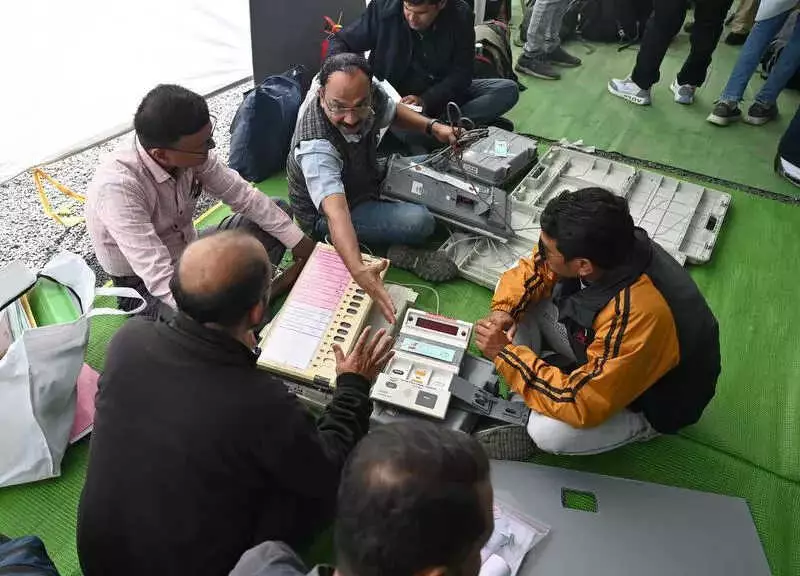
The state administration has signaled full-scale preparedness for the electoral process. Across the districts, officials have moved human resources and machinery into position, sealed Electronic Voting Machines (EVMs), and stationed polling teams. This election marks a key moment for urban local governance in Vidarbha after an extended gap.
While every district has its unique local dynamics, political observers note that the contest is particularly sharp and high-stakes in the districts of Amravati, Chandrapur, Yavatmal, and Akola. Here, factors like multiple councils, deep-seated factional rivalries, and large voter bases have intensified the competition.

District-Wise Breakdown of the Fray
Amravati: Multi-Cornered Fights and Political Families
In Amravati district, elections will be held for nine municipal councils and two nagar panchayats. Voting will take place across 366 booths, with approximately 312,000 eligible voters. Following the cancellation of the poll in Anjangaon Surji by the State Election Commission, the race now features 64 candidates for 11 president posts and over 1,000 candidates competing for 242 member seats.
The administration has deployed 1,682 officials on duty and identified 63 polling stations as sensitive. A tiered monitoring system, including web-casting from the Collectorate, has been established. Multi-cornered contests dominate most towns, with Dhamangaon Railway being a notable exception where a direct fight between the BJP and Congress is expected. The polls also present a key test for several prominent political families in towns like Daryapur and Dhamangaon.
Chandrapur: Fractured Alliances and Rebel Candidates
Chandrapur district is heading to the polls amid one of the region's most fractured political campaigns. Allies of both the ruling Mahayuti and the opposition Maha Vikas Aghadi find themselves pitted against each other in almost all 9 municipal councils and the Bhisi nagar panchayat.
The collapse of seat-sharing talks earlier has led to a surge of rebel candidates and those crossing alliance lines, muddying the electoral waters. Despite high-voltage canvassing by senior leaders, contests in most wards remain unclear with multiple claimants. The towns of Ballarpur, Bramhapuri, Mul, Rajura, Warora, Gadchandur, Chimur, Saoli, and Bhadrawati will vote under heavy administrative watch.
Yavatmal and Akola: High Voter Turnout Expected
In Yavatmal district, around 330,000 urban voters will decide the outcome for 77 president aspirants and 1,087 member candidates across 390 booths. Polls will be held for nine municipal councils—Ghatanji, Darwha, Digras, Wani, Pandharkawada, Arni, Pusad, Ner, and Umarkhed—and the Dhanki nagar panchayat, covering 124 wards. The direct elections for municipal council chiefs have raised the profile of the contests, leading to intense last-minute outreach by candidates.
Akola district has completed its preparations for polling in four municipal councils—Akot, Murtijapur, Telhara, and Hiwarkhed—and the Barshitakli nagar panchayat. Elections in Balapur remain suspended due to a pending court matter. Here, 34 candidates are contesting for President posts and 622 for council memberships. The district has deployed more than 1,100 polling personnel, backed by sector officers and police teams. Section 144 will be enforced around polling stations, with heightened security in sensitive areas.

Voters to Shape Local Governance Future
As the political temperature peaks in the final hours of campaigning, the focus now shifts to the voters. The elections represent a direct opportunity for residents across Vidarbha's towns, large and small, to shape the future of their local governance and development. The widespread administrative preparedness underscores the importance of these polls in the region's civic landscape. With more districts witnessing competitive contests this time compared to previous cycles, the outcomes will be closely watched as a barometer of local political sentiment.





