

In a landmark announcement in the Telangana assembly, Deputy Chief Minister and Finance Minister Mallu Bhatti Vikramarka unveiled an ambitious roadmap for the state's future. The 'Telangana Rising Vision 2047' document, presented on Tuesday, sets forth transformative goals aimed at reshaping the socio-economic landscape of the region over the next two decades.
Core Vision: Global Connectivity and Skilled Youth
The cornerstone of the vision is a pledge that any child born in Telangana will be within 180 minutes of a global economic centre. This ambitious connectivity goal is designed to integrate even the remotest parts of the state into the global economic mainstream. To power this growth, the government is turning to a proven international model for workforce development.
Vikramarka emphasized a critical shift in educational philosophy, moving from mere 'degrees' to practical 'competencies'. He pointed out the existing gap where industries have jobs but youth lack the requisite skills. The solution will be implemented at the Young India Skills University through the adoption of the German dual system of apprenticeship.

Under this model, students will spend three to four days gaining hands-on experience on the shop floor and only one to two days in traditional classroom settings. This approach is expected to create a industry-ready workforce aligned with market demands.
Economic Transformation and Women Empowerment
The finance minister outlined a bold target of transforming one crore women in the state into millionaires. The strategy goes beyond simply providing loans to self-help groups. It involves a structural transformation of these groups into corporate entities, digitising their repayment histories, and issuing individual credit scores.
"This will enable a woman from a remote village to access capital on par with a businessperson in Banjara Hills," Vikramarka stated. He also linked public health directly to economic ambition, committing to increase health expenditure to 8% of the Gross State Domestic Product (GSDP). He argued that an unhealthy workforce cannot build the envisioned three-trillion-dollar economy.
A Three-Part Spatial Economic Framework
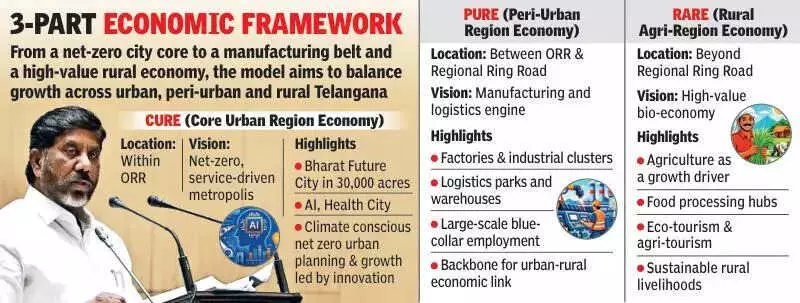
The vision document is built on a novel three-part spatial economic framework designed for balanced regional development:
CURE (Core Urban Region Economy): This zone, within the Outer Ring Road (ORR), will be developed as a net-zero, service-based metropolis. Its centrepiece will be the proposed Bharat Future City, spread across 30,000 acres. This futuristic city is planned to include dedicated clusters like an AI city and a Health City.
PURE (Peri-Urban Region Economy): The belt between the ORR and the upcoming Regional Ring Road will be developed as the state's manufacturing engine. This area will host factories, logistics hubs, and is intended to be the primary generator of blue-collar employment.
RARE (Rural Agri-Region Economy): The region beyond the Regional Ring Road will focus on revolutionizing agriculture. It will be treated as a high-value bio-economy, with significant emphasis on food processing and promoting eco-tourism to enhance rural incomes.
The presentation of Vision 2047 marks a comprehensive policy direction for Telangana, aiming to tackle development challenges through targeted spatial planning, skill revolution, and inclusive financial empowerment, particularly for women.






