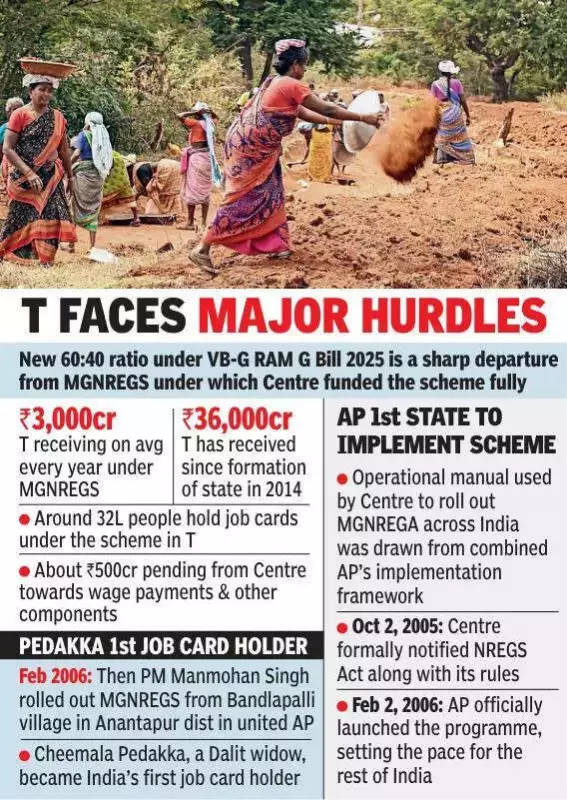
Hyderabad: The Telangana government, already grappling with financial constraints, is staring at an additional annual burden of ₹1,000 crore to ₹1,500 crore due to proposed changes in the funding pattern for a key rural employment scheme. The Centre's move to alter the Viksit Bharat Guarantee for Rozgar and Ajeevika Mission (Gramin), formerly MGNREGA, from full central funding to a 60:40 cost-sharing model has raised alarm bells in the state.
Heavy Financial Implications for a Cash-Strapped State
Under the new framework, states will be required to bear 40% of the scheme's cost, a significant departure from the past. Telangana has been receiving an average of about ₹3,000 crore annually under this scheme in recent years. Officials fear that reduced Central support will not only strain the state's coffers but could also lead to lower disbursements to beneficiaries and create operational hurdles.
The state government is currently studying the draft Bill to assess its full implications. Historical data reveals the scale of Central support Telangana has relied on. In the current financial year up to December 3, the state received ₹2,314 crore. This follows allocations of ₹3,825 crore in 2024-25, ₹3,520 crore in 2023-24, ₹2,992 crore in 2022-23, ₹4,116 crore in 2021-22, ₹4,112 crore in 2020-21, and ₹2,733 crore in 2019-20. Cumulatively, since the state's formation in 2014, Telangana has received a total of ₹36,000 crore under this scheme.

"Over the years, funding has been decreasing, and with this new 60:40 ratio, there will be a greater burden on the state," sources within the government stated. Adding to the financial pressure, about ₹500 crore is pending from the Centre towards wage payments and other components for works already executed.
Structural Differences and Implementation Challenges
The challenges are not merely financial. Officials point to structural differences in how Telangana implements the scheme compared to other states. For instance, while states like Bihar use panchayat secretaries to handle administrative work, Telangana earmarks 6% of the total funds specifically for administration. This model supports nearly 15,000 contract employees working at the ground level.
"This new rule could further impact the scheme, as there are nearly 15,000 employees on a contract basis working at the ground level," sources explained. The potential cut in central funding threatens this administrative framework, which is crucial for the scheme's operation in the state.
Further tightening of compliance norms has added to the concerns. While group photographs of completed works were acceptable earlier, the Centre now mandates individual worker photographs with geo-coordinates. These are stringently verified during central inspections, a process officials say is particularly difficult to execute consistently in remote rural areas.
‘Scheme Being Diluted,’ Warns State Minister
Telangana's Panchayat Raj Minister, Seethakka, has accused the Centre of gradually diluting the scheme. She highlighted that wage delays have already exceeded 42 days and urged the central government to provide funds without mandating the 40% state contribution. The scheme is vital for rural livelihoods, with around 32 lakh people in Telangana holding job cards under it.
Officials warn that future development works could be severely impacted. In 2025 alone, over one lakh projects were taken up, including the construction of individual household toilets, anganwadi buildings, and horticulture works covering 20,000 acres. "With new rules, all the works to be taken up further may be impacted," sources added, painting a grim picture for rural infrastructure and employment if the funding burden shifts as proposed.
The proposed change places Telangana at a critical juncture, forcing it to find resources for a centrally designed scheme at a time when its own fiscal space is limited, potentially affecting millions of rural households dependent on guaranteed work.