Telangana Government Opposes Rice Millers' Attempt to Quash Criminal Cases Over Rs 3,960 Crore Paddy Diversion
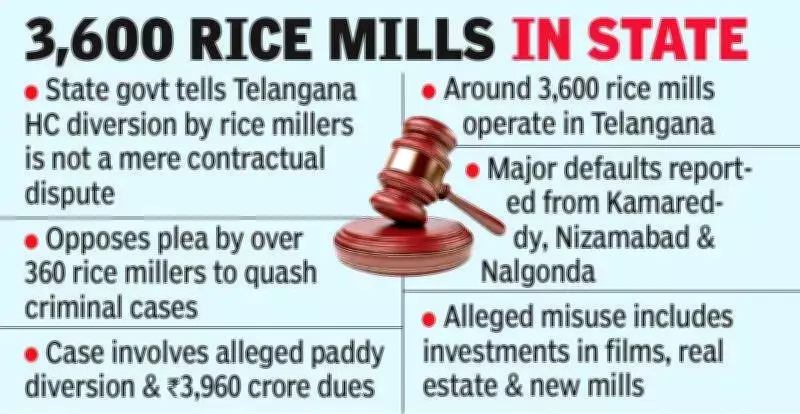
The Telangana state government has firmly opposed attempts by over 360 rice millers to quash criminal cases against them, telling the Telangana High Court that large-scale financial diversion cannot be brushed aside as a mere contractual dispute. The government's stance comes amid allegations of massive misappropriation involving paddy stocks worth Rs 3,960 crore.
Allegations of Systematic Financial Diversion
The cases relate to the alleged diversion of paddy supplied for milling and non-payment of dues amounting to Rs 3,960 crore, equivalent to the value of the paddy stocks issued by the government. According to state authorities, the millers allegedly diverted proceeds from the paddy into other ventures, including film production, real estate investments, asset acquisition, and setting up new mills in the names of family members.
There are approximately 3,600 rice mills operating across Telangana. Among the cases registered against defaulting millers, most originate from Kamareddy, Nizamabad, and Nalgonda districts, with defaults ranging from Rs 1 crore to Rs 100 crore per miller.

State's Arguments in High Court
During a hearing before Justice J Sreenivas Rao on Wednesday, public prosecutor Palle Nageswar Rao submitted that the millers had deliberately defaulted on payments. He argued that the large pending dues were adversely impacting welfare schemes undertaken by the government, placing significant burden on the state exchequer.
"While the custom milled rice policy mandates the milled rice be returned to the civil supplies department within 15 days from the collection date, these millers have been dragging the matter since the 2022-23 financial year," Nageswar Rao told the court.
The alleged misappropriation surfaced during a civil supplies department probe conducted several months ago, following which criminal cases were registered against the implicated millers. The state has urged the court to dismiss the petitions seeking to quash these cases.
Reference to Supreme Court Guidelines
Nageswar Rao also placed before the court Supreme Court guidelines from a similar case involving millers in Bihar, which mandate submission of bank guarantees before lifting paddy from procurement centers. This precedent underscores the seriousness with which such financial irregularities are treated at the highest judicial levels.
The public prosecutor emphasized that the financial scale of the alleged diversion makes this more than a simple contractual dispute, warranting continued criminal proceedings. The state maintains that the millers' actions represent a systematic attempt to circumvent government regulations and divert public resources for private gain.
Court Proceedings and Next Steps
The Telangana High Court has adjourned the matter for further hearing, allowing both sides to prepare additional arguments. The state government's opposition to the millers' petitions signals its determination to pursue accountability for what it describes as a significant financial breach affecting public welfare programs.
This case highlights ongoing challenges in agricultural supply chain management and the enforcement of financial accountability within government procurement systems. The outcome could set important precedents for how similar cases are handled across India's agricultural sector.