Telangana Congress Government Launches Historic Tribal Rehabilitation Initiative in Amrabad Tiger Reserve
In a significant move aimed at harmonizing tribal development with environmental preservation, the Congress-led government in Telangana has officially commenced the rehabilitation and relocation of tribal families residing within the ecologically sensitive Amrabad Tiger Reserve. This comprehensive initiative represents a critical effort to address the dual imperatives of improving living standards for indigenous communities while simultaneously safeguarding vital wildlife habitats.
First Phase Targets 417 Families Across Four Villages
The ambitious program has entered its initial implementation phase, focusing on the voluntary rehabilitation of 417 tribal families from four specific villages located within the reserve boundaries: Sarlapalli, Kudichintalabailu, Tatigundalapenta, and Kollampenta. Deputy Chief Minister Bhatti Vikramarka personally distributed compensation cheques worth Rs 15 lakh each to 14 beneficiary families during a formal ceremony held at the assembly council hall in Hyderabad.
The event witnessed the presence of several key ministers including Konda Surekha, Uttam Kumar Reddy, and Jupally Krishna Rao, underscoring the government's commitment to this transformative socio-environmental initiative. Deputy CM Bhatti emphasized that the administration views this rehabilitation as a fundamental responsibility toward tribal communities who have coexisted with nature in the Amrabad forests for countless generations.

Dual Compensation Options and Substantial Financial Allocation
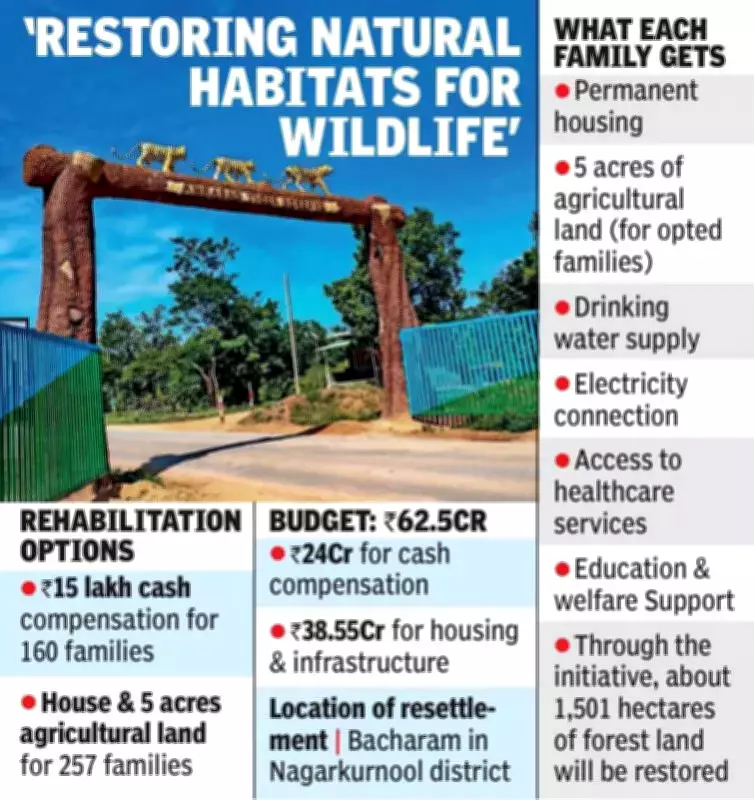
The rehabilitation scheme offers beneficiaries two distinct options based on individual preferences and needs. A total of 160 families have opted to receive direct cash compensation of Rs 15 lakh each, while 257 families have chosen the alternative package comprising modern housing facilities along with five acres of agricultural land at the designated relocation site in Bacharam, located within Nagarkurnool district.
The government has allocated a substantial budget of Rs 62.55 crore specifically for the development and rehabilitation of families from the four identified villages. This financial outlay includes Rs 24 crore designated for cash compensation payments and Rs 38.55 crore allocated for housing infrastructure and related facilities. Preliminary work on the pilot project has already commenced at the Bacharam relocation site according to official statements.
Comprehensive Development Package Beyond Mere Relocation
Deputy Chief Minister Bhatti characterized the initiative as far more than a simple physical relocation of households, describing it instead as a holistic transformation of tribal lives. The rehabilitation package extends well beyond basic housing to include comprehensive amenities such as reliable drinking water supply, electricity connections, healthcare access, and agricultural land for sustainable livelihoods.
Educational infrastructure represents another crucial component, with plans for modern schools, anganwadi centers, and digital learning facilities specifically designed to benefit tribal children. The program further incorporates economic empowerment measures through the establishment of self-help groups and skill development centers aimed at fostering financial independence and self-reliance within the rehabilitated communities.
Environmental Benefits and Wildlife Conservation Impact
This large-scale rehabilitation effort promises significant ecological advantages alongside its social development objectives. The relocation is expected to restore approximately 1,501 hectares of forest land within the Amrabad Tiger Reserve, creating expanded and uninterrupted habitats for wildlife movement. This habitat restoration is particularly crucial for endangered species including tigers, with specific measures planned to support population growth and conservation efforts.

Principal Chief Conservator of Forests Suvarna highlighted the program's potential to play a pivotal role in long-term forest conservation while maintaining equilibrium between tribal welfare and environmental protection. The Bacharam rehabilitation colony itself is being developed as a model village featuring comprehensive infrastructure including proper road networks, drinking water systems, electricity grids, educational institutions, community halls, and dedicated farmer platforms.
A Balanced Approach to Socio-Environmental Challenges
Deputy CM Bhatti emphasized the historic nature of this initiative, describing it as an unprecedented socio-environmental reform rather than a routine administrative decision. The voluntary nature of participation, based entirely on tribal family consent, represents a fundamental principle guiding the entire rehabilitation process. The Rs 15 lakh compensation package has been noted as among the most substantial such offerings nationwide for similar rehabilitation programs.
This comprehensive program is positioned to emerge as a benchmark initiative that successfully addresses the complex interplay between indigenous community development and critical wildlife conservation needs. By creating improved living conditions for tribal families while simultaneously enhancing protected forest areas, the Telangana government aims to establish a replicable model for balanced sustainable development in ecologically sensitive regions across India.