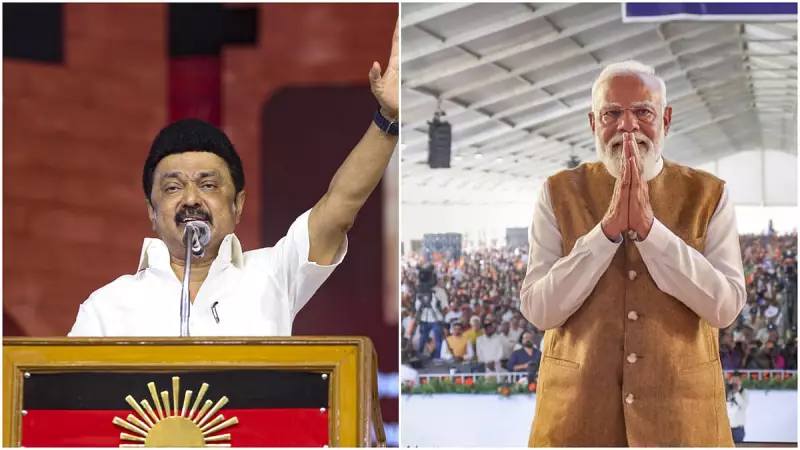
Tamil Nadu Chief Minister and Dravida Munnetra Kazhagam (DMK) leader MK Stalin has issued a strong rebuttal to Prime Minister Narendra Modi's recent advocacy of 'double engine' governance, asserting that such political rhetoric holds no sway in the culturally and politically distinct landscape of Tamil Nadu. In a pointed statement, Stalin highlighted the state's long-standing tradition of regional autonomy and its resistance to centralized political narratives, positioning this as a critical moment in the ongoing dialogue between state and central leadership.
Stalin's Firm Stand Against Centralized Governance Models
MK Stalin's response comes amid Prime Minister Modi's continued promotion of the 'double engine' concept, which suggests that having the same party in power at both the state and central levels leads to more efficient and accelerated development. Stalin, however, countered this by emphasizing Tamil Nadu's unique socio-political identity, rooted in the Dravidian movement, which has historically championed state rights and regional pride. He argued that the people of Tamil Nadu prioritize substantive governance and welfare measures over partisan alignments, making the 'double engine' pitch irrelevant to their electoral decisions.
Historical Context and Political Implications
The exchange underscores a deeper political divide, with Stalin invoking Tamil Nadu's legacy of resisting homogenization from New Delhi. He pointed to the state's achievements in social justice, education, and healthcare as evidence of its capability to govern effectively without conforming to central party ideologies. This stance is seen as a strategic move to consolidate DMK's base and appeal to voters who value regional autonomy, especially with upcoming elections in mind. Analysts suggest that Stalin's remarks aim to reinforce the DMK's position as the guardian of Tamil Nadu's interests against perceived encroachments by the Bharatiya Janata Party (BJP)-led central government.

Broader Ramifications for Indian Federalism
This confrontation highlights ongoing tensions in India's federal structure, where states like Tamil Nadu assert their distinctiveness in governance models. Stalin's rejection of the 'double engine' rhetoric may influence political discourse in other non-BJP ruled states, potentially fostering a coalition of regional parties advocating for greater state autonomy. The debate also touches on issues of development versus identity politics, with Stalin framing the 'double engine' as a tool for political centralization rather than genuine progress.
In conclusion, MK Stalin's firm opposition to PM Modi's 'double engine' concept signals a robust defense of Tamil Nadu's political sovereignty and cultural ethos. As the political landscape evolves, this exchange is likely to resonate in future electoral battles, shaping how regional and national parties engage with voters on matters of governance and identity.