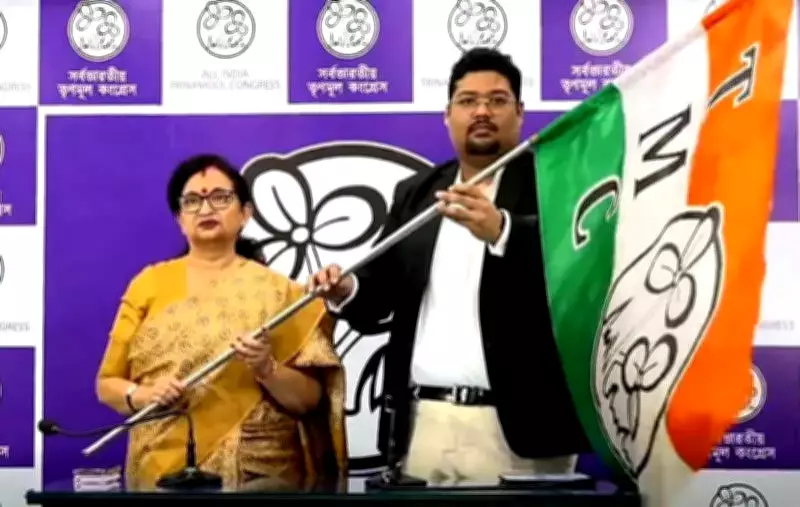
Sourav Chunder Joins Trinamool Congress, Pledges to Defend Bengali Identity
In a significant political development in Kolkata, social media influencer and advocate Sourav Chunder officially joined the Trinamool Congress (TMC) on Thursday. During his induction, Chunder made a strong statement, asserting his commitment to fight against what he described as the criminalization of Bengali identity across India. This move is seen as part of TMC's strategy to bolster its digital presence and engage younger voters ahead of upcoming political battles.
Heritage and Intellectual Credibility Highlighted by TMC Leaders
State Finance Minister Chandrima Bhattacharya, speaking to reporters after Chunder's induction, emphasized the deep-rooted heritage of the Chunder family. She noted that his ancestor, Baboo Subol Chand Chunder, was a renowned textile baron and philanthropist during the Bengal Renaissance, symbolizing an era where wealth creation was intertwined with cultural advancement. Bhattacharya further highlighted that Chunder's maternal lineage traces directly to Raja Rajendra Mullick of the Marble Palace, representing Bengal's artistic and philanthropic aristocracy that has long patronized arts, supported social reform, and preserved cultural heritage.
"This rich background has shaped his learnings and motivated him to serve society through his profession as an advocate," Bhattacharya added, underscoring how this intellectual credibility enhances TMC's appeal among youth.
Digital Influence and Youth Engagement Strategy
Bhattacharya also pointed out Chunder's significant influence on social media, describing him as a big influencer who can mobilize young audiences. "This young audience now becomes AITC's digital army in the social media battle ahead," she stated, referring to the All India Trinamool Congress. She explained that youth engagement gains intellectual depth when constitutional lawyers like Chunder use case law citations to explain agency misuse, thereby countering negative narratives effectively.
Chunder echoed these sentiments, expressing concern over a persistent negative narrative against Bengal. "There is a constant negative narrative against Bengal, trying to prove that Bengal neither had a past, nor has a present, nor will it have a future. Bengali identity is being criminalised across India," he said. He emphasized his decision to join TMC as a stand against such portrayals, aiming to highlight the positive aspects and ongoing developments in the region.
Broader Political Context and Implications
This induction comes at a time when political parties are increasingly leveraging digital platforms to shape public opinion and engage with voters. Chunder's background as an advocate and influencer positions him uniquely to address legal and social issues, potentially strengthening TMC's outreach in urban and intellectual circles. His focus on defending Bengali identity taps into regional sentiments, which could resonate with voters concerned about cultural preservation and representation.
As TMC prepares for future electoral challenges, integrating figures like Chunder is part of a broader effort to combine traditional political strengths with modern digital strategies. This move not only adds a fresh voice to the party but also signals a commitment to addressing contemporary issues through informed and influential perspectives.