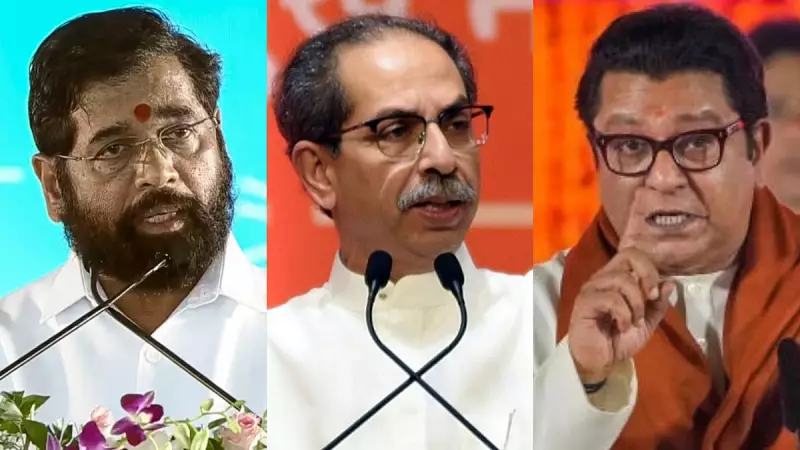
In a sharp political attack ahead of crucial municipal elections, Maharashtra Chief Minister Eknath Shinde has taken aim at his former ally Uddhav Thackeray and MNS chief Raj Thackeray. Speaking on the campaign trail, Shinde asserted that the electorate cannot be influenced by political 'brands' alone, signaling a direct challenge to the Thackeray family's legacy in the state's politics.
Shinde's Confident Assertion on Voter Sentiment
The Chief Minister made these remarks in the context of the upcoming elections for the Kalyan Dombivli Municipal Corporation (KDMC). He positioned the ruling Mahayuti alliance as a force driven by performance and grassroots connection, rather than mere name recognition. Shinde emphasized that the people's trust is earned through work, not inherited through political surnames. This commentary is seen as a significant moment in the ongoing realignment of Maharashtra's political landscape, where Shinde's faction of the Shiv Sena is directly competing against the Shiv Sena (UBT) led by Uddhav Thackeray.
Mahayuti's Strong Position: 21 Seats Unopposed
Shinde bolstered his argument by pointing to a concrete electoral achievement. He revealed that even before the polls have officially begun, the Mahayuti alliance has demonstrated formidable strength. A total of 21 candidates from the Mahayuti coalition have already been elected unopposed in the KDMC elections. This development, according to Shinde, is a clear indicator of the opposition's weakness and its inability to mount a credible challenge against the ruling alliance's candidates in those wards.

This uncontested win in a substantial number of seats provides a major morale boost for the Shinde-led alliance and is interpreted as a sign of local-level consolidation in their favor. It suggests a lack of strong opposition candidates or potential defections and withdrawals that benefited the Mahayuti.
Political Implications and the Road Ahead
The statement and the uncontested wins have several immediate consequences. Firstly, it sets a combative tone for the civic polls, framing them as a battle between a 'performance-based' model and a 'brand-based' model of politics. Secondly, it puts the Uddhav Thackeray-led Shiv Sena (UBT) and Raj Thackeray's MNS on the defensive, forcing them to counter this narrative of declining influence.
The Kalyan Dombivli Municipal Corporation elections, scheduled for the near future, are now a critical testing ground for these claims. The outcome will be scrutinized to see if Shinde's confidence translates into a sweeping victory, or if the Thackeray 'brand' still holds significant sway among the Marathi-speaking populace in this key region of Maharashtra.
As of the latest reports on 10 January 2026, the political atmosphere remains charged. Shinde's comments have ensured that the focus of these local body elections has expanded from civic issues to a larger debate on political legacy and relevance in contemporary Maharashtra.