Punjab Assembly Condemns Centre's Foreign and Energy Policies, Demands Immediate LPG Relief
The Punjab Assembly on Thursday unanimously passed a strongly worded resolution condemning the Bharatiya Janata Party (BJP)-led central government for what it termed as "failed foreign and energy policies." The resolution, moved by Food, Civil Supplies, and Consumer Affairs Minister Lal Chand Kataruchak, demanded that the Centre take emergency measures to normalize the supply of liquefied petroleum gas (LPG), reduce prices of domestic and commercial cylinders, and ensure India's long-term energy security.
Criticism of Central Government's Policies
Reading out the resolution in the assembly, Minister Kataruchak asserted that India is currently facing a severe crisis primarily due to the "failure" of the Centre's foreign policy and an "unbalanced energy strategy." He emphasized, "The current situation in India is not merely the result of international circumstances but is largely due to the weak, inconsistent, and directionless policies of the central government. Today, India's energy security faces a serious threat."
Kataruchak highlighted the practical impacts on citizens, noting, "Small restaurants, dhabas, and hotels are facing long delays in obtaining LPG cylinders and are struggling to continue operations. For households, the rising prices of domestic gas cylinders are a direct burden." He accused the central government of attempting to conceal the severity of the crisis by raising gas prices instead of reassuring citizens, raising questions about whether India's foreign policy is being influenced by select corporate interests at the expense of national energy security.
Political Reactions and Absences
Notably, BJP MLAs, including Punjab BJP working president Ashwani Sharma and Jangi Lal Mahajan, were absent during the discussion, as were the Shiromani Akali Dal (SAD) benches. Sharma and Mahajan could not be reached for comment. In response, Punjab BJP president Sunil Jakhar dismissed the resolution, stating, "These resolutions have no bearing at all. They have nothing to do with the people of Punjab. They have passed a resolution saying there is a dearth of LPG. On the other hand, Chief Minister Bhagwant Mann is putting out a post saying he has directed deputy commissioners across Punjab that there should be no dearth of LPG. This government is trying to create panic, which is against national interests as everybody would start hoarding and create shortages."
Broader Criticisms from AAP and Congress
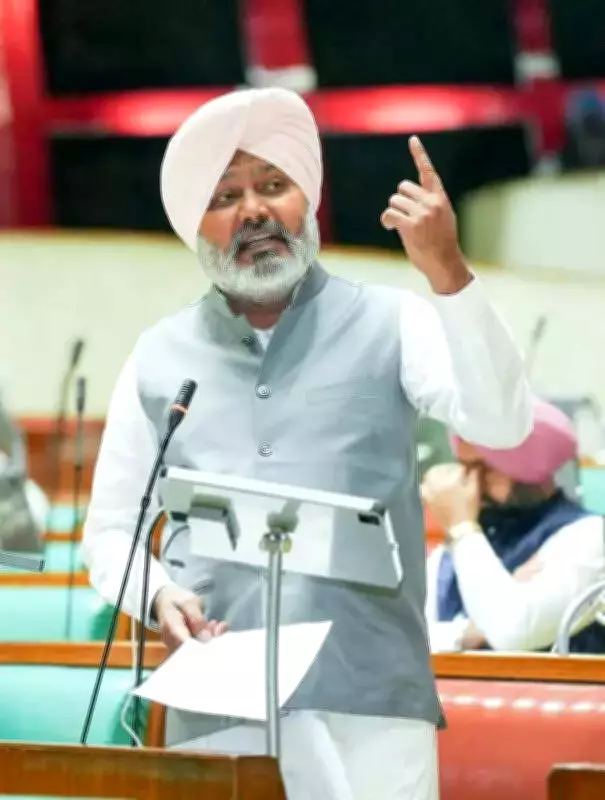
Supporting the resolution, cabinet minister Aman Arora criticized India's foreign policy for lacking clarity on allies and enemies, which he argued leaves the country vulnerable in energy, security, and global diplomacy. Finance Minister Harpal Singh Cheema went further, alleging, "Our foreign policy under Prime Minister Narendra Modi is so fragile that we are constantly intimidated by foreign powers. Whether it was the intervention via a mere tweet during past border tensions or the absolute silence on recent casualties in Iran, the Union government proved that it lacks the spine to stand up for India's strategic interests. We will not allow BJP to turn India into a subservient market for the US, nor will we let them enslave the people of this country."
AAP MLA Kuldeep Singh Dhaliwal echoed these sentiments, claiming the country was "sold out," and stated, "Trump is running the country, Modi is running BJP, and our people are suffering. Thousands became unemployed, restaurants shut down, and gas is unavailable. Our citizens need answers." He challenged Punjab BJP leaders to explain where India will source oil after supplies from Russia potentially run out in 40 days, questioning if America will dictate terms.
Historical Context and Demands
Leader of Opposition Partap Singh Bajwa from the Congress party supported the resolution, criticizing the Centre's foreign policy for weakening ties with neighboring countries such as Nepal, Bangladesh, and Sri Lanka. He contrasted this with the tenures of former Prime Ministers Jawaharlal Nehru and Manmohan Singh, when India enjoyed strong influence among developing nations and was seen as a leader of the third world. Bajwa also noted that India's energy needs were historically supported by Russia and Iran, which previously allowed oil trade in Indian rupees instead of dollars to bolster India's economy.
The resolution calls for a transparent policy that prioritizes India's national interests and urges immediate special assistance for small businesses and ordinary consumers affected by the crisis. It concludes, "The House expects that, to prevent such situations in the future, India's foreign and energy policies are restructured to ensure national and economic stability while safeguarding the needs of the common people."