Pune Corporators Rally Against Massive Water Charge Demand
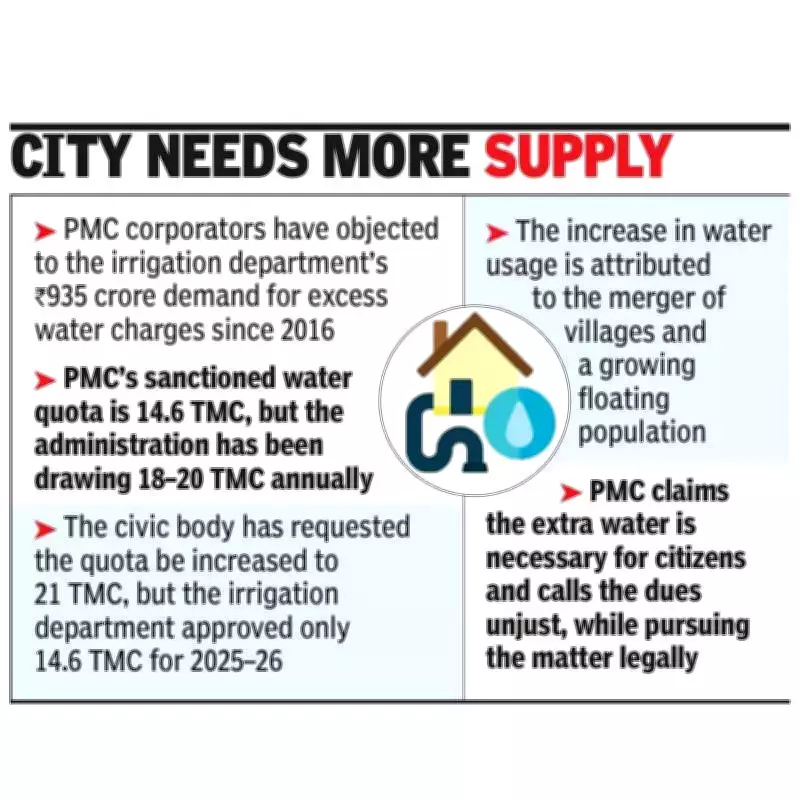
In a significant development, newly elected corporators in Pune, including representatives from the ruling Bharatiya Janata Party (BJP), have strongly objected to the irrigation department's demand for approximately Rs 935 crore in water charges. The department asserts that the Pune Municipal Corporation (PMC) must pay this substantial amount as charges and arrears for drawing water beyond its sanctioned quota since 2016, sparking a heated debate over resource allocation and civic responsibilities.
Quota Shortfall and Population Growth Drive Dispute
The core of the conflict lies in the water quota allocation. The PMC is officially sanctioned to draw 14.6 TMC (thousand million cubic feet) of water annually. However, reports indicate that the administration has been consistently drawing between 18 TMC and 20 TMC each year to meet escalating demands. This overuse has led to the hefty financial claim from the irrigation department, which PMC officials argue is unjust given the city's rapid expansion.
Following the merger of 32 villages into Pune's jurisdiction, the municipal area expanded dramatically from 334 square kilometers to 518 square kilometers, making PMC the largest municipal corporation in Maharashtra, surpassing even the Brihanmumbai Municipal Corporation (BMC). This growth has fueled a surge in population, now estimated to exceed 80 lakh residents, including a substantial floating population, thereby increasing water consumption beyond the outdated quota limits.

Political and Administrative Responses
Opposition leader Nilesh Nikam emphasized the necessity of the additional water draw, stating, "The administration must make efforts to resolve this issue amicably. The city is expanding rapidly, and so is the water demand. Drawing additional water has become a necessity and is meant solely for the citizens. Discrimination against the citizens of Pune is unjust." His comments highlight the civic body's stance that the extra water usage is essential for public welfare, not mismanagement.
On the political front, BJP party leader Ganesh Bidkar voiced firm opposition, declaring, "We oppose the demand. The issue will be raised with the state government. The civic body should not be required to pay these unjust dues. The matter is already being pursued through legal channels." This indicates a multi-pronged approach involving both governmental intervention and legal recourse to challenge the irrigation department's claims.
Efforts to Revise Quota and Conserve Water
In response to the quota inadequacy, PMC formally requested the irrigation department in July 2025 to sanction an increased annual water quota of 21 TMC for the financial year 2025–26. However, the department only approved the existing 14.6 TMC, exacerbating tensions. A senior PMC official explained, "The quota sanctioned by the irrigation department is insufficient. The city's population has crossed 80 lakh, including a substantial floating population. The water supply must be adequate to meet this demand."
To address water management concerns, PMC has implemented measures such as the equitable water supply scheme aimed at reducing wastage and leakage. The official added, "PMC is also taking steps to reduce water wastage and leakage. The equitable water supply scheme was introduced to conserve water. Therefore, PMC should be allocated a higher quota." These conservation efforts underscore the civic body's commitment to efficient resource use while advocating for a revised quota that aligns with Pune's current needs.
The dispute underscores broader issues of urban planning and resource allocation in rapidly growing Indian cities, with Pune's case serving as a critical example of the challenges faced by municipal bodies in balancing expansion with sustainable water management.