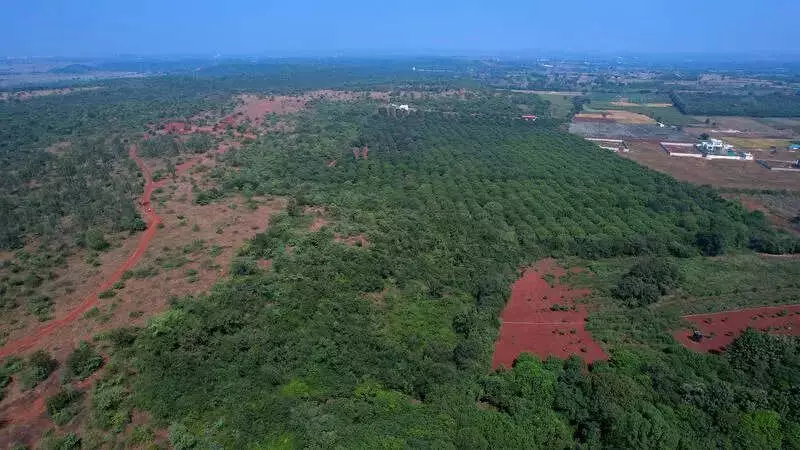
In the Vikarabad district of Telangana, a newly elected village head is stepping into a role with responsibilities that extend far beyond the typical concerns of rural governance. While most new sarpanches focus on local infrastructure like drains, roads, and water supply, the mandate for the leader of Pudur gram panchayat is intertwined with India's national defence architecture.
A Strategic Installation in a Village's Backyard
Pudur's significance stems from the fact that it encompasses the Damagundam forest reserve, the chosen site for the Indian Navy's very low frequency (VLF) communication station. This is a highly sensitive strategic installation, pivotal for secure, long-range communication, especially with submarines operating in challenging maritime conditions. The project, with an estimated cost of ₹3,200 crore and spanning nearly 2,900 acres, had its foundation stone laid in November 2024 by Defence Minister Rajnath Singh in the presence of Chief Minister A. Revanth Reddy.
The sarpanch of Pudur is not a mere bystander in this massive undertaking. He functions as an ex-officio stakeholder, whose consent, approvals, and signatures are required at multiple stages of the project's implementation. This unique position places the gram panchayat alongside central authorities, meaning the sarpanch's concurrence is needed in addition to statutory clearances from the Ministry of Defence, the Ministry of Environment, Forest and Climate Change, and other agencies.
Balancing National Security with Local Apprehensions
This role necessitates direct coordination with senior defence and environmental officials, granting the village head an unusually influential voice in a project of national importance. However, this influence comes with the weight of representing deep-seated local anxieties. The project remains a source of significant unease in Pudur and neighbouring villages.
Residents are looking to their new leader to forcefully articulate their concerns, particularly regarding the environmental impact. A major point of contention is the scale of deforestation. While official figures state 7,000 trees were felled, locals claim the actual number is vastly higher. "The actual number runs into over one lakh trees, claiming damage to the forest," said Swamy Satynand, a local priest. He further warned that the project could adversely affect the flora and fauna of the Damagundam reserve and impact surrounding villages.
The New Sarpanch's Dual Challenge
All eyes are now on Pudur's newly elected sarpanch, Khizar Pasha, who won the panchayat election by a margin of 186 votes. Acknowledging the complexity of his mandate, Pasha described his victory as both a privilege and a profound responsibility.
"I will hold discussions with villagers and take collective decisions on the future course of action regarding the proposed VLF station," Pasha stated, emphasizing a democratic approach. He faces the delicate task of facilitating a critical national defence project while being the primary advocate for his constituents' environmental and livelihood worries. "At the same time, I am committed to ensuring that Pudur emerges as a model village," he added, outlining a vision that must reconcile local development with a national strategic imperative.
The journey ahead for Sarpanch Khizar Pasha will be a tightrope walk, testing his ability to mediate between the uncompromising demands of national security and the legitimate ecological fears of his community.