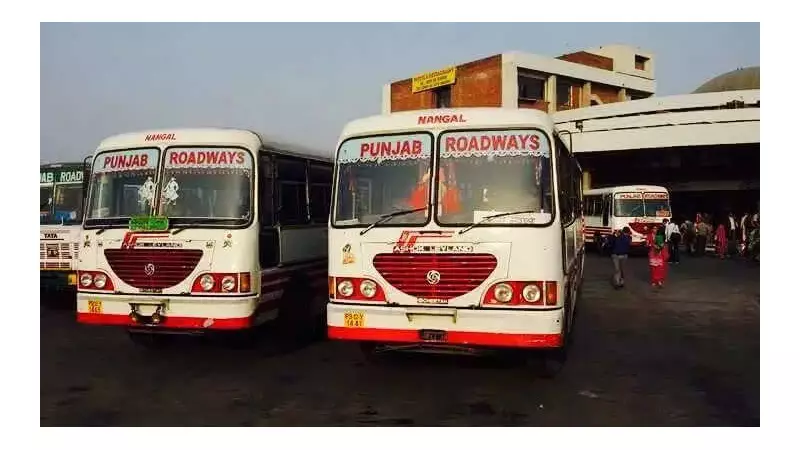
The year 2024 has been marked by severe disruptions in Punjab's state-run bus services, as contractual employees of the Pepsu Road Transport Corporation (PRTC), along with their counterparts in Punbus and Punjab Roadways, have resorted to 15 strikes so far. These repeated agitations, driven by demands including the cancellation of tenders for private buses under the kilometre scheme, have crippled public transport and inflicted heavy financial losses on the corporations.
Mounting Financial Toll of the Agitations
The cumulative impact of these strikes has been staggering. PRTC Managing Director B S Shergill revealed that the 15 strikes have resulted in a receipt loss of approximately Rs 14 crore for the corporation alone. The most recent four-day strike, which ended on a Tuesday afternoon, contributed an estimated Rs 3 crore to this total. Similarly, officials from Punbus and Punjab Roadways reported collective losses exceeding Rs 9.4 crore over the year due to employee strikes.
To put these figures in perspective, the PRTC generates daily receipts between Rs 2.5 crore and Rs 3 crore, while Punjab Roadways and Punbus each earn around Rs 2 crore per day. A significant portion of this revenue, nearly half, comes from concessional or free passengers, including women travellers whose fares are reimbursed by the state government.
The Heart of the Conflict: Kilometre Scheme vs. Public Ownership
The central point of contention is the government's kilometre scheme, which involves hiring buses from private operators. The employees' unions view this as "privatisation in disguise" and a threat to their job security. Management, however, presents a financial argument. Shergill stated that adding 100 new buses to the PRTC fleet would require an investment of about Rs 40 crore, making the kilometre scheme a cheaper short-term alternative. He noted that only 13% of PRTC's 1,181-strong fleet currently runs under this scheme, compared to 23-25% in other states.
Union leaders vehemently disagree. Gurpreet Singh, Vice-President of the PRTC Punbus Contractual Employee Union, argued that the money lost to strikes could have been used to buy new buses. "The state government should provide a one-time special grant to the PRTC to purchase new buses instead of allowing backdoor privatisation," he said. Singh challenged the corporation to an open debate, claiming that PRTC-owned buses, with a lifespan of 15 years, are more profitable in the long run than hired buses which run for only six years under the scheme.
Broader Demands and Public Impact
Beyond opposing the kilometre scheme, the strikes have also been called over delayed salaries, pending dues, and demands for regularisation of employment. Gurpreet Singh highlighted that delays in the government clearing free travel concession dues lead to salary delays for employees, forcing them to protest. "We do not want to harass the public... but we are forced to go on strike," he stated.
The agitations have had a severe impact on commuters, particularly women who rely on the state's free travel scheme, often leaving them with no choice but to turn to more expensive private operators. The tensions escalated in cities like Patiala and Sangrur, witnessing clashes, attempts at self-immolation, and police detentions. Services partially resumed only after the state government revoked cases against protesters and suspended sackings.
The timeline of key strikes this year includes a three-day strike from January 6-8 for regularisation, a two-hour strike on April 24 over unpaid March salaries, a major statewide disruption on August 13 by 8,000 workers, and the final four-day strike that concluded recently. With employees resuming work after the latest government assurances, the state holds its breath, hoping for a permanent resolution to this costly standoff.