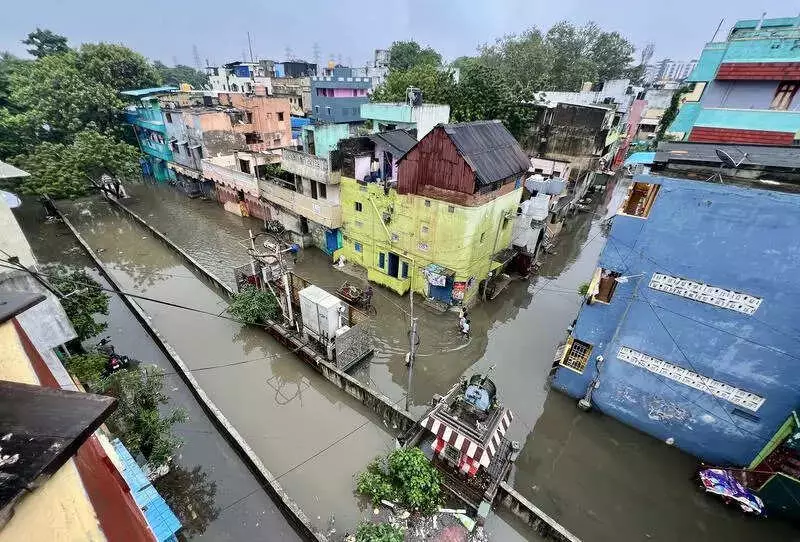
Heavy overnight monsoon showers pounded several neighbourhoods in North Chennai from Monday night through Tuesday forenoon, leading to significant rainfall accumulation and severe waterlogging in multiple localities. While some areas with the highest rainfall remained surprisingly free of inundation, others with comparatively lesser rain faced crippling floods, exposing critical gaps in the city's drainage infrastructure.
Rainfall Data and the Waterlogging Paradox
As per the 24-hour readings recorded until 5:30 AM on Tuesday, Parry's Corner area received the highest rainfall at 26.5 centimetres. It was closely followed by Ennore at 26.4 cm, Basin Bridge at 20.7 cm, and Manali at 20.6 cm. Despite these intense spells, these specific zones managed to avoid major water accumulation.
In a stark contrast, localities like Vyasarpadi, Purasawalkam, Otteri, and Perambur, which received between 13 cm to 15 cm of rain, were plunged into chaos. Vyasarpadi's Mullai Nagar recorded 13.4 cm, while Perambur faced 14.5 cm. Here, key arterial roads and interior lanes were submerged under ankle to knee-deep water, which persisted well into Tuesday evening.
Life Disrupted: Roads and Railways Crippled
The consequences of the flooding were severe and immediate. Access to two crucial railway stations—Vyasarpadi and Perambur—was completely cut off, stranding commuters. Major stretches including Erukkancheri High Road, Vyasarpadi Industrial Estate, Stephenson Road, Ganeshapuram Main Road, and Perambur High Road became impassable.
Residents recounted harrowing experiences of being trapped. On Ganeshapuram Main Road, people from nearly 100 houses found themselves unable to step out due to knee-deep water. Commuters trying to navigate using digital maps found every possible diversion route blocked by flooded stretches and road closures. The situation at the key junction connecting Stephenson Road to Dr Ambedkar Salai was particularly dire, with hip-deep water marooning all four sides and severing the link between North Chennai and Central Chennai areas, including the route to Chennai Central railway station.
Official Response and Infrastructure Failure
The scale of the inundation prompted visits from high-ranking officials in the afternoon, including Deputy Chief Minister Udhayanidhi Stalin, Municipal Administration and Water Supply Minister K N Nehru, and Chennai Mayor R Priya.
Officials pinpointed the failure of the stormwater drainage system as the primary cause. G Chokkalingam, the GCC zonal officer for Thiru Vi Ka Nagar, revealed that the stormwater drain channel from Perambur to Vyasarpadi and the Otteri Nullah were clogged. The blockages were only identified on Monday evening, and though most were cleared by Tuesday, the drain's capacity was deemed insufficient to handle the volume of rainwater.
Compounding the problem, the Otteri Nullah had swollen from the previous day's rains, submerging the outfall points of the stormwater drains. This created a reverse effect, preventing neighbourhood water from draining into the canal. To tackle the flooding across these affected neighbourhoods, the Greater Chennai Corporation (GCC) had only four motor pumps at its disposal, with just two being high-powered units to drain water into the Otteri Nullah.
The event underscores a persistent urban challenge for Chennai, where despite infrastructure claims, intense rainfall repeatedly overwhelms systems, disrupting daily life and mobility for thousands of residents.