Nagpur's Growing Traffic Nightmare: From Smooth Roads to Daily Gridlock
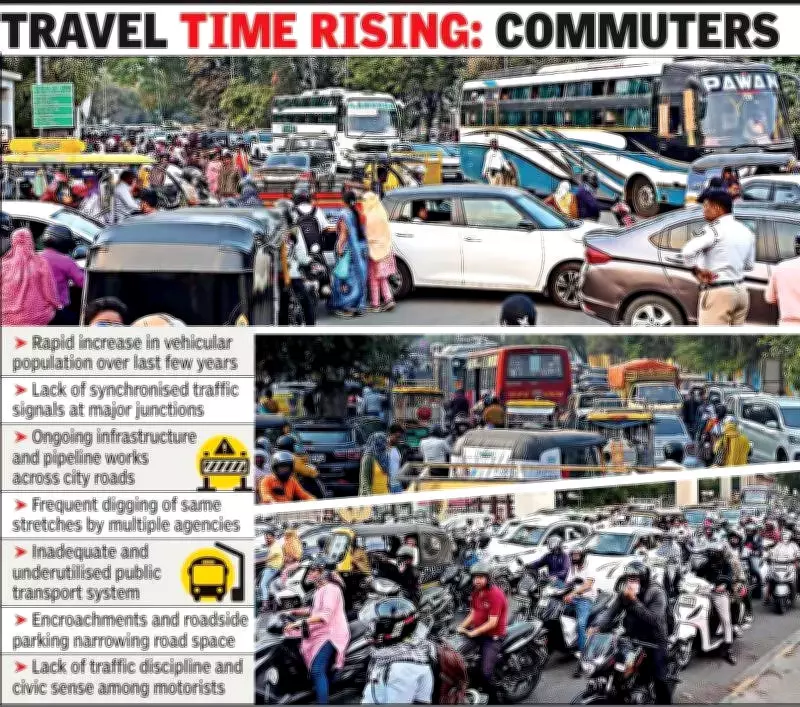
Nagpur, a city once celebrated for its relatively open roads and efficient traffic flow, is now grappling with a severe and persistent congestion crisis. Commuters across the city are reporting steadily increasing travel times, even during hours traditionally considered light for traffic, leading to widespread frustration and delays.
Major Arteries and Internal Roads Paralyzed by Congestion
The traffic woes are most pronounced on several key arterial routes that serve as the city's lifelines. Wardha Road, Kamptee Road, Inner Ring Road, Central Avenue, and Koradi Road now frequently experience traffic jams throughout the day, not just during rush hours. Additionally, numerous internal stretches within the city are similarly affected, creating a network of bottlenecks.
Motorists describe a situation where vehicles crawl at slow speeds, and it is common to wait through traffic signals two or three times before successfully crossing a junction. This phenomenon, once rare outside peak office hours, has become a daily reality for Nagpur's drivers.

Expert Analysis: A Multifaceted Problem
Traffic experts and civic activists point to a combination of interconnected factors driving the worsening situation. Ashok Karandikar, a member of Janakrosh, identifies the city's exploding vehicular population as a primary culprit. "Today, motorists are forced to wait at signals 2 to 3 times even during non-peak hours," he stated, highlighting the scale of the problem.
Karandikar elaborated on the contributing issues: "The rapid rise in vehicles, lack of signal synchronisation, ongoing infrastructure works, and inadequate public transport are all adding to the problem." He also cited poor traffic discipline among motorists as a significant aggravating factor.
Proposed Solutions: Public Transport and Coordination
To combat the crisis, Karandikar emphasised the urgent need to strengthen Nagpur's public transportation system to reduce dependency on private vehicles. He suggested that improving first- and last-mile connectivity could incentivize more residents to opt for buses, the Metro, and other shared transport options.
"Multiple steps, including the use of proper technology, can help reduce traffic congestion," he added. "There is also a critical need for better coordination among agencies, as many times the same road stretch is dug up repeatedly for different utility works, causing unnecessary and prolonged disruptions."
Citywide Impact and Official Response
The congestion has spread to numerous prominent areas across Nagpur. Residents report heavy traffic becoming a regular feature in Sitabuldi, Sadar, Mankapur, Manewada, Besa, Ramdaspeth, Dhantoli, Nandanvan, Ajni, and Medical Square. The problem, which intensified gradually over the past few years, is no longer confined to traditional peak office hours.
DCP (Traffic) Lohit Matani acknowledged the challenges, linking them to the growing vehicle population and an increasing number of working professionals putting pressure on city roads. He pointed to a technological solution on the horizon: the Intelligent Traffic Management System (ITMS).
"The working population in the city increased, and so did the number of vehicles," Matani said. "However, once the ITMS is implemented completely in the next 6 to 7 months, traffic signal synchronisation and other integrated measures will help manage congestion more effectively."
The situation presents a clear call to action for city planners, traffic authorities, and citizens alike. Without coordinated efforts to improve public transport, enforce discipline, and implement smart traffic management, Nagpur's roads risk descending into permanent gridlock, affecting the quality of life and economic productivity for all its inhabitants.