Kerala Minister's Unusual Action in Landslide Survivor's Home Ignites Dispute
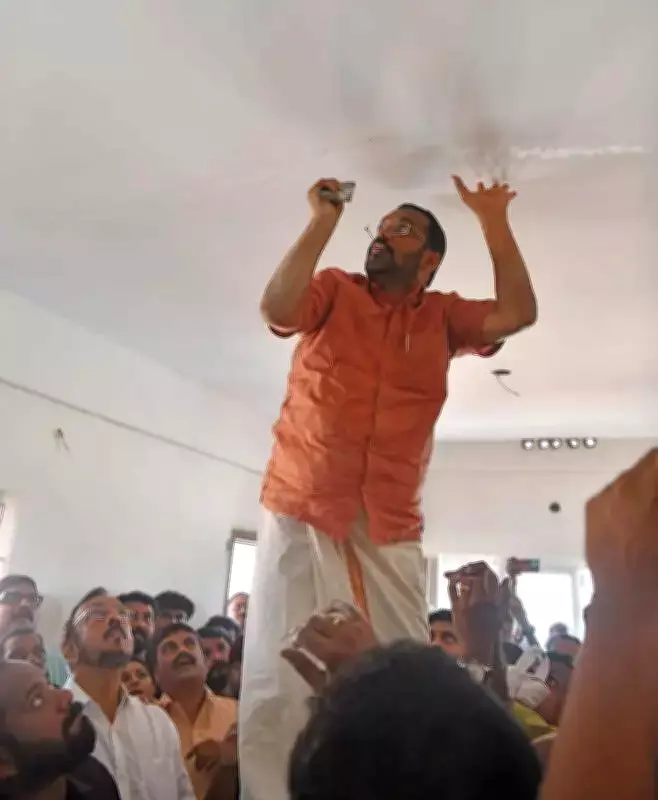
In a controversial incident in Kozhikode, Kerala Revenue Minister K Rajan personally erased a marking on the ceiling of a house constructed for survivors of the devastating Wayanad landslide. The minister's visit followed allegations of cracks appearing in the roof of one of the homes built under the township project for those affected by the Mundakkai-Chooralmala disaster.
Minister's On-Site Investigation and Erasure
Minister Rajan arrived at the house allocated to a survivor, climbed a ladder, and used sandpaper to remove pencil markings on the ceiling. He challenged the media present, asking if anyone doubted his conclusion that it was not a crack. "There is a small mark of water seeping in, and around it marking has been made using a pencil. If it was a crack, it couldn't be scratched off. I checked it personally," Rajan stated, asserting that the marking was merely indicative of water seepage and not a structural flaw.
Beneficiary's Strong Objection and Emotional Plea
Noufal, the beneficiary who owns the house, vehemently opposed the minister's actions. He revealed that officials from Uralungal had made the marking to identify a leak, not him. "Is there a necessity for a minister to come here and erase that mark?" Noufal questioned, emphasizing that as the homeowner, he should have been consulted. He showed journalists cracks on the roof and underneath, along with seepage evidence, expressing distress over the erasure.

Noufal shared his profound grief, having lost sixteen family members in the landslide. "After constructing a house of mine, I didn't have the luck to stay in it. I am in this grief and seeing these cracks I am in mental agony," he said. He added that the minister did not speak to him during the visit and that he is now facing threats after raising the complaint. "I don't know what to tell the minister if he says it is not a crack, don't you all know that it is a crack?" he lamented.
Minister's Assurance and Technical Clarifications
In response, Minister Rajan explained that all issues would be rectified before the official handover of the houses. He clarified that only property documents (patta) were formally handed over initially, with key handover being a technical step. When reporters pointed out marks on the roof and confirmed water seepage, Rajan attributed it to incomplete waterproofing procedures.
"Water was stagnant above it for 24 hours, and a small seeping of water was found. It would be cured, and water would be filled again," he assured. The minister outlined remedial measures:
- Epoxy treatment and additional waterproofing layers if effective
- Concreting with a thickness of 2 to 7 cm above the affected area
- Handover only after these repairs are completed
He highlighted that the contract includes a five-year defect liability period, during which ULCC (Uralungal Labour Contract Cooperative Society) must address any post-handover cracks. Rajan confirmed that all 178 houses in the project will undergo examination by ULCC and beneficiaries before final handover.
This incident has sparked a debate over transparency and beneficiary rights in rehabilitation projects, with the survivor's emotional outcry contrasting sharply with the minister's technical assurances.