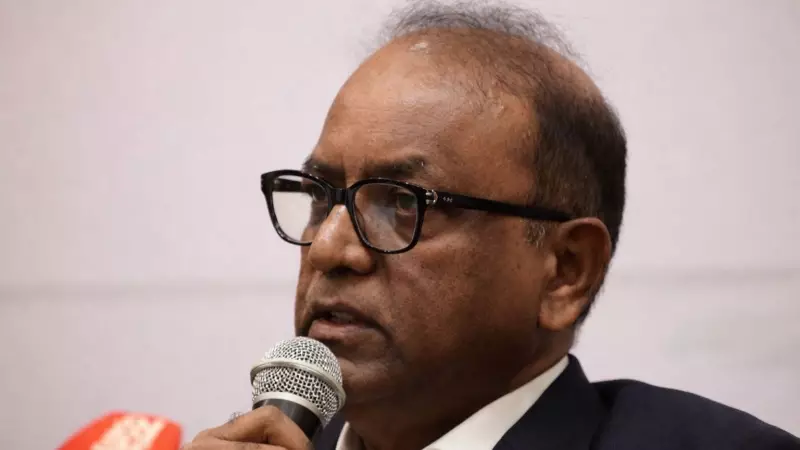
Maharashtra Election Chief Under Fire Amid Poll Controversies
Maharashtra State Election Commissioner Dinesh T Waghmare finds himself at the center of a political storm. The veteran bureaucrat faces mounting criticism as multiple issues plague the ongoing municipal corporation elections across the state.
Who Is Dinesh Waghmare?
Dinesh Waghmare is a 1994-batch Indian Administrative Service officer of the Maharashtra cadre. He assumed the role of State Election Commissioner on January 28, 2025. This appointment came shortly after his retirement as Additional Chief Secretary to the state government.
Waghmare brings impressive academic credentials to his position. He holds a BTech in Electronic Engineering from Visvesvaraya National Institute of Technology in Nagpur. He also earned an MTech in Computer Science from IIT Kharagpur. Furthermore, he completed an MSc in Development Project Planning from the University of Bradford in the United Kingdom.

His administrative career spans several key assignments within the Maharashtra government. Waghmare served as Principal Secretary in multiple important departments including Home, Energy, and Social Justice. He also chaired the Maharashtra State Electricity Transmission Company Limited as its Chairman and Managing Director.
The officer gained valuable urban governance experience as Municipal Commissioner of both Pimpri Chinchwad and Navi Mumbai. His diverse portfolio includes serving as Divisional Commissioner of Amravati, Collector of Buldhana, and Chief Executive Officer of various Zilla Parishads. Additionally, he chaired the Nagpur Improvement Trust during his extensive career.
Current Election Controversies
The current municipal elections represent one of Maharashtra's largest civic exercises. Over 3.48 crore voters across 29 municipal corporations are participating in this democratic process. However, the election commission faces serious allegations of mismanagement and irregularities.
Shiv Sena (UBT) president Uddhav Thackeray has demanded Waghmare's immediate suspension. Opposition parties and voter groups have raised multiple concerns about the election process. Their criticisms focus on several specific issues that emerged after the election schedule announcement.
Key complaints include:
- Delays in uploading candidates' affidavits to the public domain
- Permission granted for door-to-door campaigning during the final 48 hours before voting
- Introduction of PADU (Printing Auxiliary Display Unit) machines during vote counting in Mumbai
- Implementation of staggered vote counting procedures
- Alleged mishandling of complaints regarding unopposed election victories
- Reports of Model Code of Conduct violations going unaddressed
Polling day witnessed additional problems that fueled the controversy. Questions emerged about the quality of indelible ink used to mark voters. Some voters claimed the ink could be easily wiped off, raising concerns about potential duplicate voting.
Waghmare's Defense
The State Election Commissioner has strongly defended the election process. He addressed the indelible ink controversy directly and firmly. Waghmare stated that the commission uses the same ink employed since 2011, now applied through marker pens.
"The ink requires approximately 10 to 12 seconds to dry completely," Waghmare explained. "Voters remain inside the polling booth during this drying period. Once properly dried, the ink cannot be removed. This is identical to the ink used by the Election Commission of India."
Waghmare warned of serious consequences for any election malpractice. "If double voting occurs, we will take strict action against the presiding officer of that polling booth," he declared. The commissioner also placed some responsibility on voters themselves.
"Voters must not attempt to rub off the ink before it dries," Waghmare emphasized. "Removing ink prematurely constitutes the voter's fault. We can register criminal cases against such individuals."
The election chief accused some parties of spreading misinformation. He promised to investigate social media videos circulating about the ink controversy. "We will take appropriate action against anyone found spreading fake narratives," Waghmare asserted.

Regarding confusion over polling booth locations, Waghmare suggested voters should have checked details online beforehand. He maintained that adequate information was available through official channels.
Previous Controversy
This is not Waghmare's first encounter with political controversy. Before becoming State Election Commissioner, he served as Secretary of the Social Justice Department. In 2017, his son received a government scholarship meant for Scheduled Caste students to study at Pennsylvania State University.
Opposition parties alleged conflict of interest in this matter. Waghmare defended the decision, noting that income limits had been relaxed years earlier. He explained that students admitted to top-ranked global universities received exemptions from income caps. No official action resulted from this episode, but it attracted significant political attention at the time.
The current election controversies present Waghmare with his most significant challenge yet as State Election Commissioner. With counting underway and results pending, all eyes remain on how his commission handles the mounting criticism and technical complaints.