

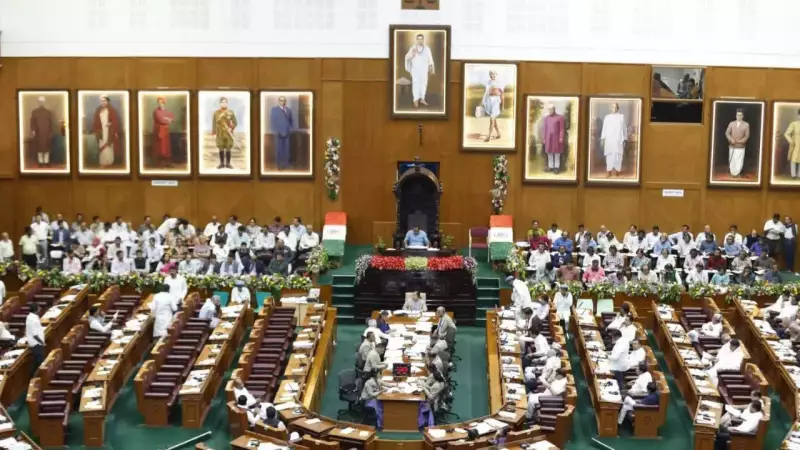
In a historic and contentious move, the Karnataka Legislative Assembly on Thursday passed the pioneering Karnataka Hate Speech and Hate Crimes (Prevention) Bill, 2025. The landmark legislation, a first of its kind in the state, introduces severe penalties for offenses driven by prejudice, but its passage was marred by strong opposition and uproar from BJP members.
Stringent Provisions and Opposition Uproar
Piloted by state Home Minister G Parameshwara, the bill was taken up for passage on December 10 amid a din. The assembly witnessed chaos when Speaker UT Khader presented the bill, with BJP legislators storming the well and staging a dharna. The protest was triggered by an unsavoury comment made by Urban Development Minister Byrathi Suresh regarding coastal districts. Although the speaker expunged the remark, BJP members remained dissatisfied, demanding an apology.
BJP's V Sunil Kumar accused the government of suppressing dissent, stating, "While the govt is aiming to suppress voices of dissent through hate speech legislation, what we witnessed in the House was suppressed opposition as the bill was passed ignoring our concerns."

Key Punishments and Broad Definitions
The bill takes a serious view of acts motivated by prejudicial interests on a wide range of grounds including religion, race, caste, community, sex, gender, sexual orientation, place of birth, residence, language, disability, and tribe.
As outlined by Minister Parameshwara, hate crimes will be punishable with imprisonment of not less than one year, extending up to seven years, along with a fine of Rs 50,000. For subsequent or repeated offences, the jail term will be a minimum of two years, extendable to ten years, with a heftier fine of Rs 1 lakh. Critically, all offences under this act will be cognisable and non-bailable, with trials to be conducted by a first-class magistrate.
The legislation defines hate speech comprehensively as any expression—spoken, written, through signs, visible representations, or electronic communication—made in public view with the intent to cause injury, disharmony, enmity, hatred, or ill-will against a person or group.
Controversial Clauses and Fierce Criticism
One of the most debated provisions holds organisations liable for crimes committed by their members. The bill states that if any member commits a hate crime, the entire organisation will be deemed guilty, though the term "organisation" itself remains undefined.
Leader of the Opposition R Ashoka launched a scathing attack, labelling the law "draconian." He warned, "A police officer will become a Hitler under this law. Freedom of expression will be violated, and freedom of press will come under threat." He argued that the existing Bharatiya Nyaya Sanhita already covers such offences, making a separate law unnecessary and politically motivated. "This is a Brahmastra against the opposition," Ashoka claimed, adding, "We will be the first to bear the brunt and next in line will be media. Ultimately, it is vote bank politics."
Ashoka also objected to the use of the Kannada term "dwesha aparadaha" for hate crime, asserting it does not exist in the standard Kannada lexicon. The session remained volatile, with further uproar following an oblique reference by Minister Suresh to communal violence in the coastal region.
The passage of this bill marks a significant, yet deeply polarizing, step in Karnataka's legal framework, setting the stage for intense debate on the balance between curbing hate speech and protecting fundamental freedoms.






