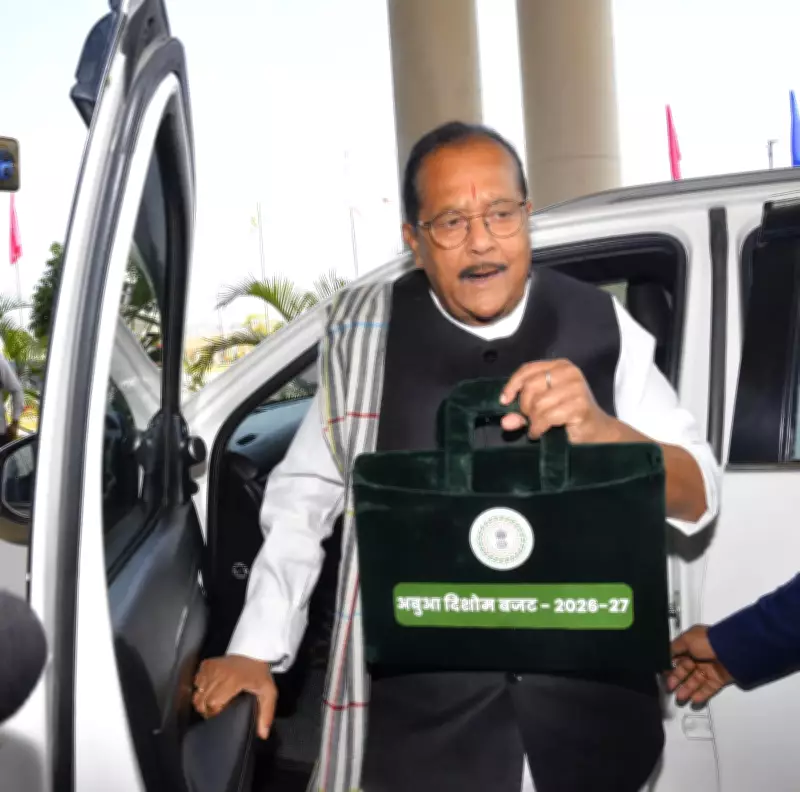
Jharkhand Unveils Ambitious Abua Dishom Budget for 2026-27 Fiscal Year
In a significant legislative event, Jharkhand Finance Minister Radhakrishna Kishore arrived at the state Assembly in Ranchi, carrying the traditional budget briefcase to present the annual financial plan for the 2026-27 fiscal year. The budget, officially titled the 'Abua Dishom Budget' as a tribute to the late JMM patriarch and statehood leader Shibu Soren, proposes a substantial total outlay of Rs 1,58,560 crore. This marks an approximate 9% increase compared to the previous financial year's allocation, signaling the government's commitment to accelerated development across the state.
Major Allocations and Sectoral Focus
The budget demonstrates a strong emphasis on social welfare, with about 28.38% of the total outlay dedicated to women and child welfare initiatives. Specifically, Rs 34,211 crore is classified as the gender budget, while Rs 10,793.16 crore is earmarked for the child budget. Finance Minister Kishore highlighted that the budget prioritizes boosting the rural economy, livelihoods, the agricultural sector, and social security, alongside providing significant impetus to key areas such as health and education for the overall development of Jharkhand.
Presenting the budget for the second consecutive time, Kishore announced the establishment of a new university named after Baba Bhim Rao Ambedkar in Chatra district during the new fiscal year. This initiative is positioned as a fitting tribute to the Father of the Constitution by the JMM-led alliance government, underscoring the administration's focus on educational advancement.
Health, Agriculture, and Infrastructure Investments
In a major health sector push, a dedicated Rs 200 crore has been allocated for cancer prevention from the total outlay. This funding is intended to set up and install PET and CT scan machines for cancer detection across all government hospitals and to roll out facilities for breast cancer detection at every district hospital, aiming to enhance healthcare accessibility and early diagnosis.
To empower women farmers, Rs 25 crore has been earmarked under the Mahila Kaushal Khushali Yojana to link them with integrated farming practices. Additionally, Rs 162.20 crore is set aside for establishing solar-based cooperative marketing complexes in every assembly constituency, providing proper market access for farmers and promoting sustainable energy solutions.
For rural livelihood enhancement, the government announced the revival of the 'Kundri Lah' farm, described by the finance minister as the largest in Asia but defunct for years. Infrastructure development receives a boost with Rs 1,000 crore allocated for making and repairing rural roads under the CM Gram Sadak Yojana, and Rs 730 crore exclusively reserved for rural bridges and related infrastructure projects.
Financial Breakdown and Revenue Projections
Of the total budget outlay, Rs 1,20,851.90 crore is proposed for revenue expenditure, while Rs 37,708.10 crore is designated for capital expenditure. From a sector-wise perspective, the social sector receives the largest share at Rs 67,459.54 crore, followed by the economic sector at Rs 59,044.63 crore, and the general sector at Rs 32,055.83 crore.
To meet these budgetary requirements, the state expects Rs 46,000 crore from its tax revenue and Rs 20,700 crore from non-tax revenue. Central assistance is projected at Rs 18,273.66 crore, with the state's share in central taxes estimated at Rs 51,236.38 crore, and public debt contributing Rs 22,049.96 crore.
For the 2026-27 fiscal year, the fiscal deficit is estimated at Rs 13,595.96 crore, representing 2.18% of the estimated Gross State Domestic Product (GSDP). The government aims to double this in the next five years, targeting a growth rate of about 14% at current prices and 9% to 10% at constant prices to achieve this objective.
Criticism of Central Government and Political Reactions
Finance Minister Kishore expressed strong criticism towards the central government, citing hurdles posed by untimely financial assistance and grants. He emphasized that financial support from the Union government is crucial for any state, particularly a backward one like Jharkhand. Kishore revealed that approximately Rs 5,000 crore of Jharkhand's share in central taxes is pending in the current financial year, along with Rs 11,000 crore under grants that have not been received. He noted a continuous reduction in grant amounts over the past five years.
Additionally, due to the rationalization of Goods and Services Tax (GST), the state is expected to suffer an annual loss of Rs 4,000 crore, with a further Rs 5,640 crore annual loss anticipated once the VB-GRAM G scheme is introduced. Despite repeated efforts, the Centre has not disbursed Jharkhand's outstanding amount of Rs 1.35 lakh crore due from coal companies, according to the finance minister.
Chief Minister Hemant Soren hailed the budget, stating that it is aimed at fulfilling people's aspirations across all sectors. He emphasized that several provisions have been made to ensure a smooth and momentum-filled journey towards making a youthful Jharkhand prosperous by 2050, with these measures expected to translate into reality in the coming days.
In contrast, the opposition BJP criticized the budget as directionless. State BJP president Aditya Sahu addressed the media, pointing out that the state government has only been able to spend 50% of the budget in the ongoing fiscal year. He challenged the government's claims about the outstanding amount of Rs 1.36 lakh crore from the Centre, stating that the state has failed to explain under which heads this amount is pending despite repeated inquiries. Sahu also noted the absence of any proposal in the budget to provide gas cylinders for Rs 400, as promised in the ruling party's manifesto.