

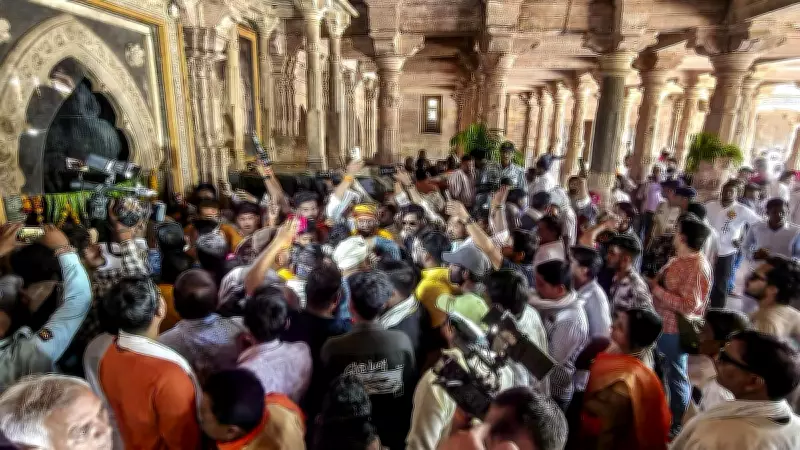
On the first Friday following the Madhya Pradesh High Court verdict on the Bhojshala-Kamal Maula Mosque complex, Hindus performed a grand 'Maha Aarti' at the site, while Muslims offered namaz at their homes, wearing black bands as a mark of protest.
Background of the Verdict
The Madhya Pradesh High Court, on May 15, ruled that the disputed complex was a temple dedicated to Goddess Vagdevi. The court also quashed an earlier order by the Archaeological Survey of India (ASI) that had permitted Muslims to offer namaz at the site on Fridays.
Events of the First Friday
In response to the verdict, Hindu devotees gathered at the Bhojshala complex to conduct a 'Maha Aarti', a significant religious ritual involving the singing of hymns and the waving of lamps. The atmosphere was charged with devotion as participants celebrated the court's decision.

Meanwhile, members of the Muslim community chose to offer their Friday prayers at home, wearing black bands to express their dissent against the ruling. This act of silent protest was observed across various localities, with community leaders urging restraint and adherence to legal processes.
Reactions from Both Communities
Hindu leaders expressed satisfaction with the High Court's verdict, stating that it upheld historical and religious truths. They called for peace and harmony, urging all parties to respect the judicial decision.
Muslim representatives, while accepting the court's order, voiced concerns over the loss of a place of worship. They emphasized that their protest was peaceful and within the bounds of the law, and they would explore further legal options.
Security Arrangements
Authorities deployed heavy security around the Bhojshala complex and sensitive areas to prevent any untoward incidents. The district administration maintained a close watch, ensuring that both events proceeded without any clashes.
Historical Significance of Bhojshala
The Bhojshala complex, located in Dhar district, has been a subject of contention for decades. Hindus claim it as a temple of Goddess Saraswati (Vagdevi), while Muslims have used it as a mosque (Kamal Maula Mosque) for centuries. The ASI had earlier allowed Muslims to pray there on Fridays, a practice that was challenged in court.
Legal Implications
The High Court's verdict is expected to have far-reaching implications for similar disputed religious sites in India. Legal experts believe that the decision could set a precedent for resolving such conflicts based on historical evidence and archaeological findings.
Both parties have been advised to maintain peace and await the final outcome of any appeals that may be filed in the Supreme Court.






