Election Commission Reverses Kolkata Motorcycle Ban Following Public Outcry
In a dramatic turn of events on Tuesday evening, the Election Commission executed a swift reversal of its earlier order prohibiting motorcycle riding in Kolkata during the pre-election period. This decision came mere hours after the initial announcement, following significant public backlash and criticism from citizens across the city.
Initial Ban and Official Justification
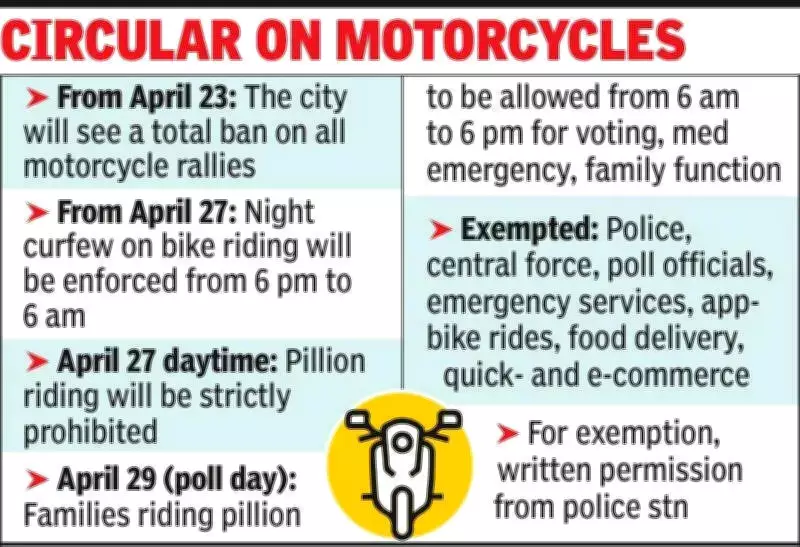
The original directive, issued by Bengal Chief Electoral Officer Manoj Agarwal, imposed a comprehensive ban on motorcycle rallies and movements within the city starting Thursday. Furthermore, from April 27, a strict curfew on bikes and bike rallies was scheduled to be enforced daily between 6 pm and 6 am.
The circular explicitly stated that bike movements would be completely prohibited in 152 Assembly constituencies spanning 16 districts from 6 pm on Tuesday until the conclusion of the first phase of voting on Thursday. A similar prohibition was set to be implemented in Kolkata from April 27, precisely two days before the city's polling date on April 29.

CEO Manoj Agarwal defended the ban, asserting it was specifically designed to curb the "movement of toughs and miscreants" and was not intended to target the general public. He emphasized that the measure aimed to enhance election security and prevent potential voter intimidation, booth jamming, and political violence.
Exemptions and Public Confusion
The order did include several key exemptions for essential services. These exemptions covered:
- Police and central security forces
- Polling officials and election-related personnel
- Emergency medical services
- App-based bike riding services
- Food delivery and quick commerce operators
- E-commerce logistics and delivery personnel
Despite these exemptions, the announcement created widespread confusion and distress among daily commuters who rely exclusively on two-wheelers for transportation. Many were left perplexed about how to manage their daily travel routines during the restricted period.
Public Reaction and EC Clarification
Following an outpouring of public outrage, CEO Agarwal issued a clarification in the evening, assuring citizens that "no general public, office commuters would be stopped or harassed." He reiterated that the ban was specifically meant for troublemakers and not for ordinary citizens going about their daily business.
Nevertheless, the initial circular had already sparked considerable concern among Kolkata residents. Many worried about the additional financial burden and increased commute times they would face if forced to switch to public transportation.
Sayantan Bhattacharya, an employee at a private firm, expressed his dilemma: "How can I travel to my office in Sector V, which is 26 km from my home in Tollygunge? Travel by other modes of transport will not only cost me a lot but also increase my commute time significantly."
Sandip Sarkar, a resident of Golf Green, highlighted the practical challenges: "I depend on my bike to meet clients and for outdoor visits. Also, I can reach home from work on a bike in half an hour. A bus ride would take almost two hours, severely impacting my productivity and personal time."
Specific Restrictions and Police Concessions
From April 27 onwards, during the period of bike restrictions, exceptions will be granted for documented emergencies such as medical crises or essential family functions. Additionally, pillion riding has been prohibited during daytime hours from April 27 to prevent what authorities describe as "mobilisation of troublemakers."
Kolkata Police has made minor concessions for essential tasks, including the transportation of schoolchildren and handling of medical emergencies. Acting on directives from the CEO, Police Commissioner Ajay Nand issued an order on Tuesday imposing several prohibitions aimed specifically at preventing electoral malpractices and violence within the metropolitan area and parts of South 24 Parganas under Kolkata Police jurisdiction.

The Election Commission's flip-flop on this issue underscores the delicate balance between ensuring election security and minimizing disruption to citizens' daily lives during the crucial polling period.