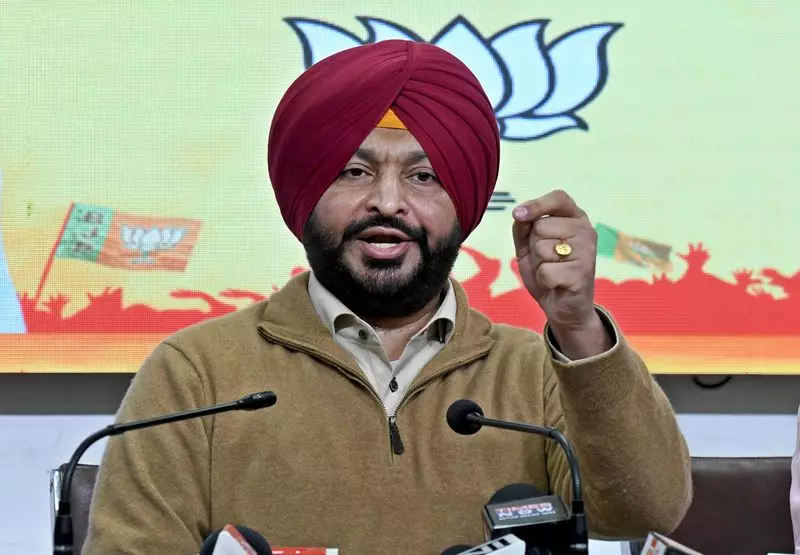
In a notable political development, Congress Member of Parliament Ravneet Singh Bittu has publicly voiced his support for granting parole to detained Khalistan sympathizer and MP, Amritpal Singh. This stance highlights a significant moment in Punjab's complex political landscape, where legal procedures intersect with humanitarian considerations.
Congress Leader's Stand on Legal Fairness
Ravneet Singh Bittu, who represents the Ludhiana constituency, articulated his position clearly. He emphasized that his support is rooted in the principle of fairness within the legal system. Bittu stated that if the law permits parole for any individual, including Amritpal Singh, then it should be granted without prejudice. He clarified that his advocacy is not an endorsement of Singh's ideology but a defense of due process. This distinction underscores a commitment to the rule of law over political or ideological alignment.
The Congress MP further elaborated that every citizen, regardless of the charges against them, has certain legal rights. His comments bring attention to the procedural aspects of detention and the provisions for temporary release available under Indian law. Bittu's remarks are particularly significant given the high-profile and sensitive nature of Amritpal Singh's case, which has been a focal point in discussions about separatism and national security.
The Case of Amritpal Singh
Amritpal Singh, the controversial Waris Punjab De chief, has been in detention since April 2023 under the National Security Act (NSA). He was arrested by Punjab Police in Moga's Rode village, following a widespread crackdown. Singh is currently lodged in Assam's Dibrugarh jail along with several of his associates. The charges against him are serious, relating to activities perceived as a threat to national integrity.
The context of his detention is crucial. His arrest came after a month-long pursuit by authorities, marking a tense period in Punjab. The use of the NSA, which allows for preventive detention, indicates the government's assessment of the potential threat. The decision to house him in a prison far from Punjab has also been a point of discussion, often seen as a measure to prevent any local mobilization or unrest.
Political Reactions and Implications
Bittu's support for parole has drawn attention from various political quarters. It presents a nuanced position within the Congress party, which has historically taken a strong stand against separatist movements. His statement may be viewed as an attempt to appeal to a sense of judicial equity, potentially resonating with certain voter segments in Punjab who prioritize civil liberties.
However, this move is not without its risks. It could open the party to criticism from political opponents who advocate for a harder line against figures like Amritpal Singh. The Bharatiya Janata Party (BJP) and other national parties are likely to scrutinize this stance closely. The reaction from the ruling Aam Aadmi Party (AAP) government in Punjab will also be pivotal, as they are directly responsible for law and order in the state.
The broader implication touches on the balance between state security and individual rights. Bittu's intervention adds a new dimension to the ongoing debate about how India handles cases involving separatist rhetoric. It raises questions about rehabilitation, legal process, and the pathways available for individuals in prolonged detention without trial. The parole question, therefore, is more than a legal formality; it is a litmus test for the application of humanitarian principles in politically charged cases.
As the situation develops, all eyes will be on the Punjab government and the central authorities. Their decision on the parole application will signal the prevailing approach towards such detainees. Whether Amritpal Singh is granted temporary release or remains in custody, the discussion ignited by Ravneet Bittu's comments is sure to continue, influencing political narratives in Punjab ahead of future electoral battles.