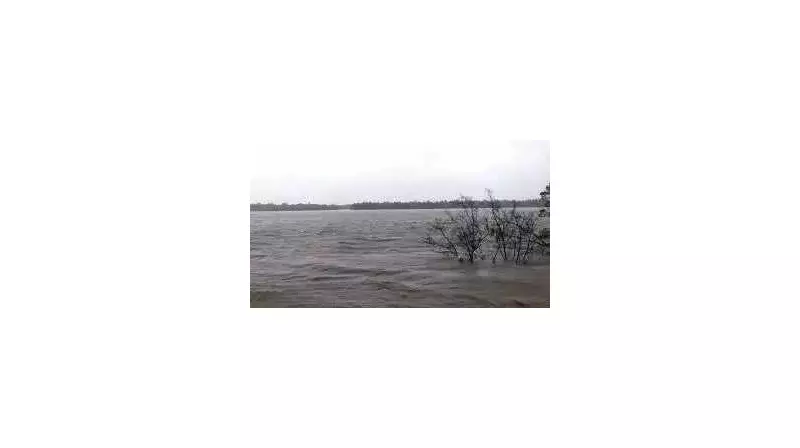
In a strategic move that has significantly bolstered Chennai's water security, the Tamil Nadu Water Resources Department (WRD) successfully managed reservoir inflows to ensure ample reserves for the coming year. The decision, taken in late October, has resulted in the Poondi reservoir reaching near-full capacity, providing a comfortable buffer for the city's drinking water needs.
Strategic Halt to Inflows Yields High Rewards
Facing the prospect of monsoon water going to waste, the state WRD made a formal request to neighbouring Andhra Pradesh in late October to temporarily halt the release of water from the Kandaleru reservoir into Tamil Nadu's systems. This proactive step allowed Chennai's own catchment areas and lakes, including Poondi, to fill up naturally with the seasonal rainfall, thereby strengthening the metropolitan region's water portfolio.
The pause on inflows from Kandaleru to the Poondi reservoir in Tiruvallur district has been a resounding success. A senior WRD official confirmed that abundant monsoon rainfall in Poondi's own catchment area and in neighbouring regions of Andhra Pradesh played a major role in replenishing the storage. Consequently, the department has now requested that the water flow from Kandaleru only be resumed by April next year, citing sufficient reserves from the recent rains.

Reservoir Levels Paint a Picture of Plenty
The current storage data reveals a highly positive scenario for Chennai. The Poondi reservoir now holds an impressive 3,114 million cubic feet (mcft) of water, which is 96% of its total capacity of 3,231 mcft. This is a crucial addition to the city's supply, where the monthly demand stands at approximately 1,000 mcft.
The combined storage across Chennai's six key reservoirs, which includes the Veeranam tank in Cuddalore district, presents an even more reassuring picture. The total storage has reached 11,749 mcft against a combined full capacity of 13,222 mcft. Officials have expressed confidence that these comfortable levels assure an adequate water supply to meet Chennai's requirements for the next 11 months.
Detailed Breakdown of Reservoir Storage
The health of individual reservoirs further underscores the city's strong water position:
- Poondi: 3,114 mcft (96% of 3,231 mcft capacity).
- Red Hills: 3,251 mcft (against 3,300 mcft full capacity).
- Cholavaram: 579 mcft (against 1,081 mcft capacity).
- Kannankottai Thervoikandigai: 464 mcft (against 500 mcft capacity).
- Veeranam Tank: 978 mcft (about 67% of its 1,465 mcft capacity).
Enhanced Supply and Distribution in Effect
With such robust reserves, the Chennai Metropolitan Water Supply and Sewerage Board (Metrowater) has been able to continue and even increase its daily water supply. The agency is currently supplying 1,230 million litres per day (mld) to consumers, which is notably higher than the 1,091 mld supplied during the same period last year.
An official from Metrowater explained the distribution process for water from Poondi. Since the Poondi reservoir does not have its own water treatment plant, WRD engineers release about 40 mld daily to the Red Hills reservoir. The water is treated at Red Hills before being channeled into the distribution network for the city's residents.
The substantial storage in the Veeranam tank, which is currently at 67% of its capacity, further reinforces the stability of Chennai's water supply chain. Authorities remain optimistic that these collective sources will comfortably sustain the needs of Chennai's residents for at least the next year, marking a period of strong water security for the coastal metropolis.